The Art of Plating
10 May 2026
The visual language of flavor
May-June 2026
Written By: Daria Smith
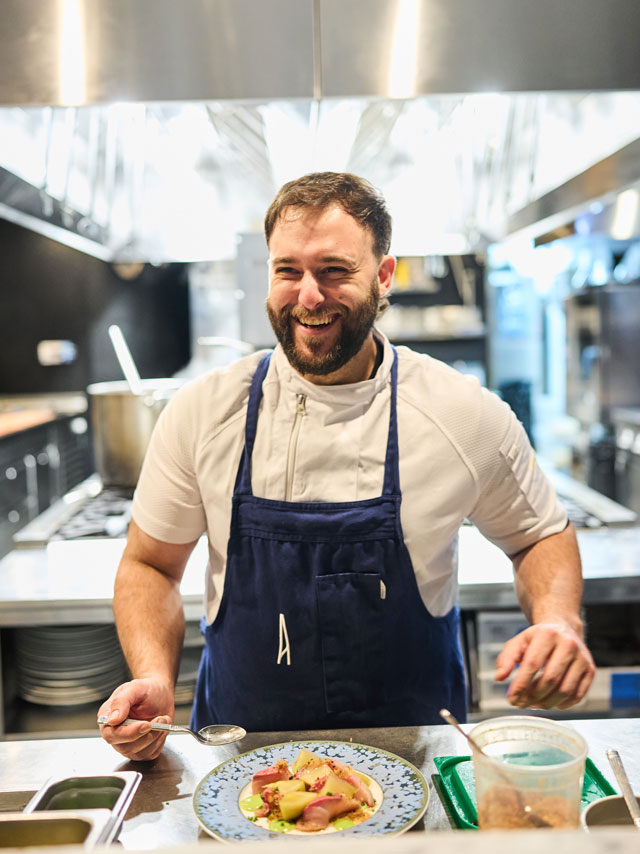
Before the first bite is taken, a dish has already begun its work. It arrives at the table as a composition, an opening statement to set the tone for the rest of the meal. Plating has become one of the defining expressions of a chef's philosophy: a window into identity, seasonality, and culture that communicates far more than what's on the menu. In Charleston, four of the city's most inventive dining rooms offer distinct answers to this essential question: What does a plate say before you taste it?
Across Circa 1886, Sushi Bar, Wild Common, and Zero George, four distinct philosophies arrive at the same conclusion: the plate is not decoration. Rather, it is the first language of a meal.
_________________________
Sushi Bar
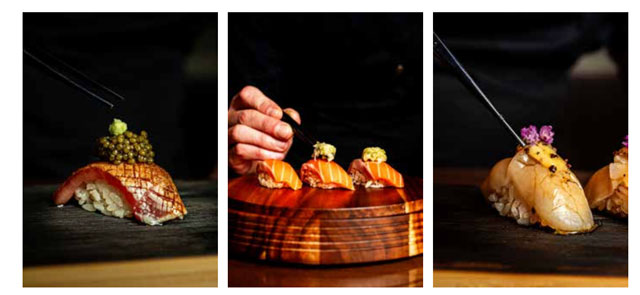
Behind an unmarked door on Church Street in the French Quarter, Sushi Bar offers a 17-course omakase tasting menu around an intimate 12-seat bar. The evening commences with a welcome cocktail. Each piece of nigiri is prepared tableside by Anthony Martin or one of his chefs in real time, akin to a performance. Opened in December 2025, securing a reservation has already become something of a sport.
The live format influences how Martin thinks about presentation. Every bite must be beautiful and efficient. “It’s like watching ballet,” he says. “It should look effortless and confident when done properly.” His restrained aesthetic highlights premium ingredients, wagyu, imported and seasonal fish, and unexpected toppings, to carry the visual as much as the flavor. “Guests eat with their eyes first,” Martin observes.
“The further along I go in my career, the more I find myself focusing on the beauty of simplicity,” he says. Seasonality is the story, and nature dictates many of his plating designs. Selecting the best possible ingredient is the first act of design, and the rest flows from there. “I always try to create an emotional connection with guests,” he says. “Having a few playful or unexpected presentations helps create that connection.”
_________________________
Circa 1886
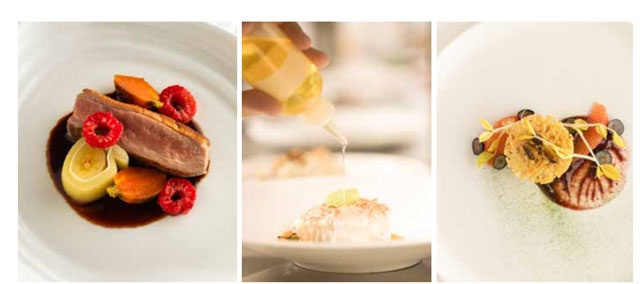
Nestled in the original carriage house of the Wentworth Mansion®, Circa 1886 has anchored Charleston’s fine dining scene since 2000. For Chef Marc Collins, plating begins with flavor. Presentation, he explains, tends to arrive at the end of the process, once a creation has been fully developed. “I’m trying to build a dish that I feel is well-developed and delivers on all levels,” he says. “Once we’ve had those flavor profiles and textures put together, then we can decide how best we want to showcase that as art on a plate.”
Collins pays close attention to how his guests actually eat. “Everything on the plate should be in one bite,” he says, “because all of those textures, flavors, and nuances are meant to be enjoyed together.” He invokes the famous scene from Ratatouille, in which cheese and strawberry, an unlikely pairing, send the critic into a moment of pure epiphany, and it’s an apt analogy.
After a quarter of a century at Circa, Collins has seen his plating style evolve dramatically. Today, he offers the Cooper and Ashley tasting menus, inviting pairs of adventurous diners to experience 10 distinct courses. He wants to push patrons to the edge of their comfort zone, but not over it. “I want to try and find some familiarity in a dish that a person can latch onto,” he says. Take the strawberry shortcake, every expected element is present—but reimagined as a vanilla bean soufflé, domed and dusted with powdered sugar, served alongside Grand Marnier ice cream and a small carafe of strawberry syrup.
_________________________
Wild Common
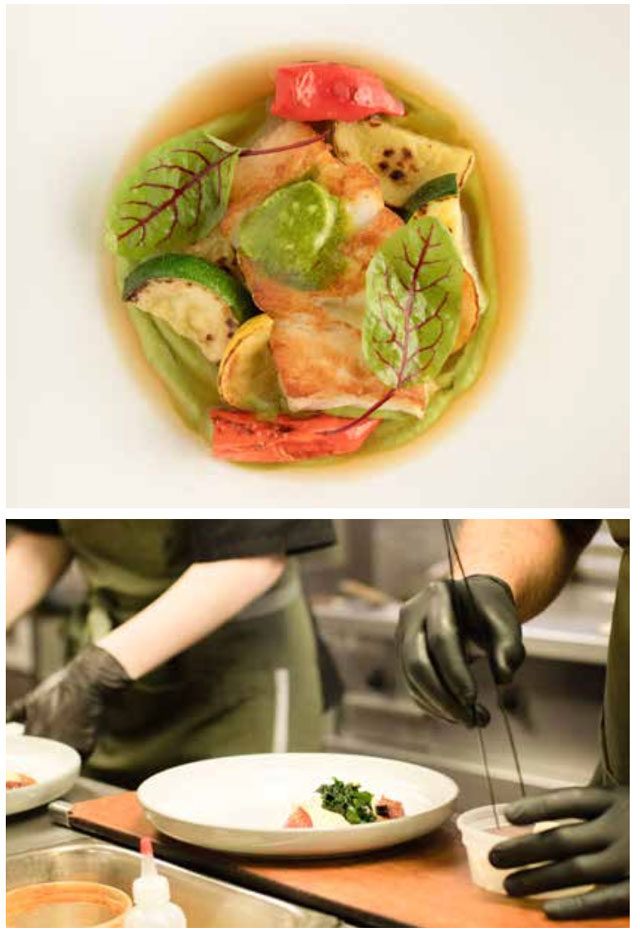
Chef Orlando Pagán’s Wild Common presents a shifting six-course tasting menu that incorporates global flavors, hyper-local ingredients, and dishes ranging from Charleston gold rice sourdough to adult “ants on a log” as the final course. The childhood snack is reborn with peanut crémeux and wine-poached raisins topped with pickled celery granita and black sesame. Candlelit tables and cane-back chairs frame the dining room, and a dramatic backlit wall of wine bottles and trailing greenery at the bar lends the space the feeling of a well-appointed greenhouse.
Plating is a form of storytelling, and the work behind each preparation is extensive. “There is a lot of time and discussion that goes into a dish’s development,” he explains. “Sometimes weeks of working through an idea, or even months of waiting on the season to change in order to highlight produce at its peak.” When a course reaches the table, every component has been examined for what it contributes to the narrative.
“Everything on the plate has a purpose,” he says. The goal is to honor traditions of global culinary cultures of origin, not simply to borrow their visual vocabulary. When a course draws on Japanese, Latin, or Southeast Asian influences, the plating needs to stay true to heritage as it weaves in Lowcountry ingredients.
Pagán also speaks to a cultural hunger for minimalism that he sees reflected in the restaurant industry’s current direction. “I’ve seen more refinement in simplicity, and an inclination to highlight all the essential pieces without overwhelming a dish with unnecessary components,” he says.
_________________________
Zero George
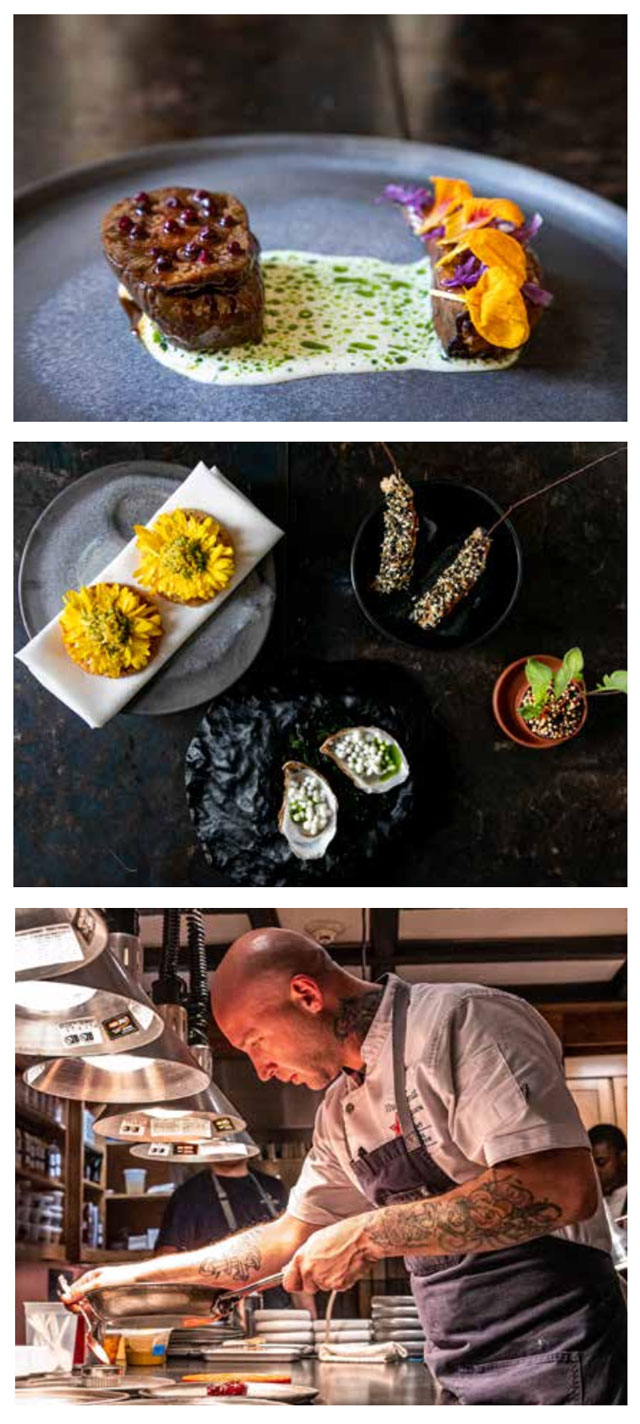
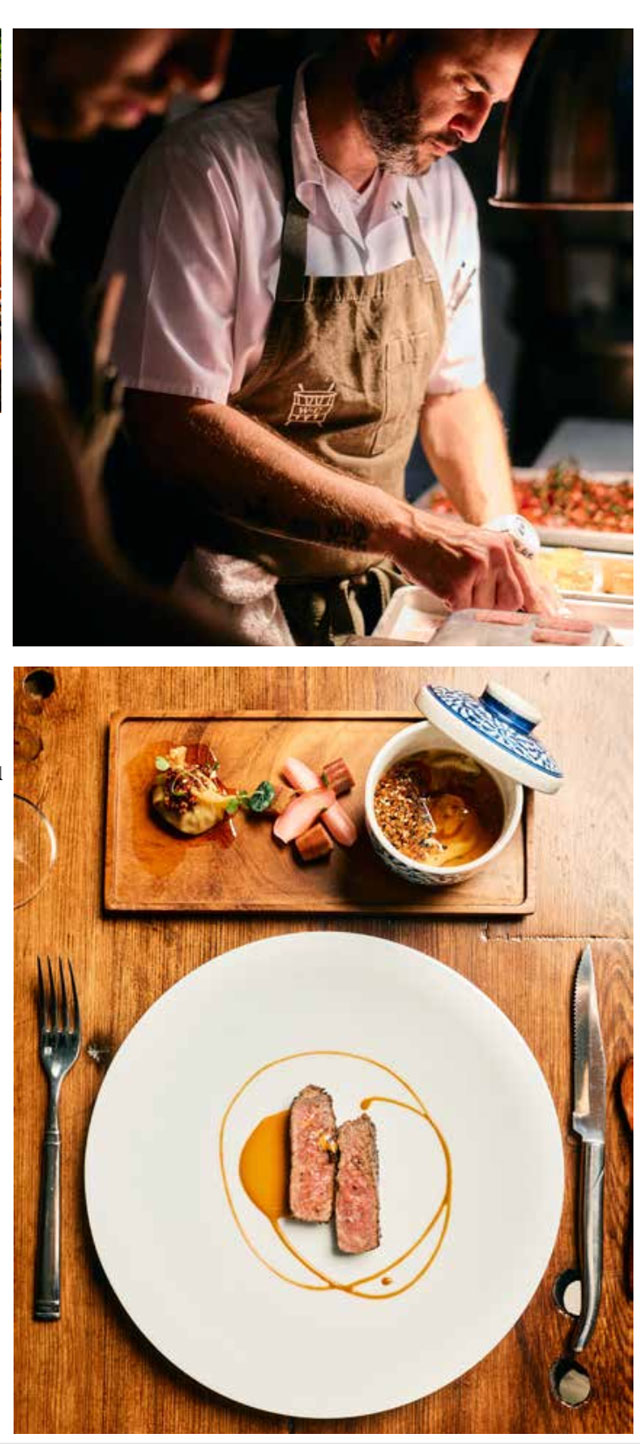
Brick pathways wind beneath a canopy of trees, as white-columned porches hung with gas lanterns give way to an intimate dining room. The setting of the Zero George hotel invites a step back in time. Chef Vinson Petrillo’s tasting menu insists on moving forward. A weathered terracotta pot arrives first; mossy and entirely edible, its “soil” concealing a pocket of seaweed butter beneath two freshly sprouted leaves. The beef tartare lands disguised as a cigar. At Zero George, nothing announces itself plainly, and that’s precisely the point.
Petrillo views presentation as the careful management of surprise, the meticulous unveiling of something the patron didn’t anticipate. “Sometimes we hide our food,” he says, “building layers of flavor that look simple on the plate, but completely surprise you with temperatures, textures, and unexpected flavors.” He is also attuned to how plating can locate a dish in a season. “Spring is recognizable in the restaurant with lots of green colors, ingredients peeking through ice to symbolize spring is here,” he observes.
Everything is weighed, cut to a precise shape; every purée is strained multiple times to ensure it looks as smooth as it tastes. “Care is taken to make our food look like nature,” he says, “for guests to be in the moment, in the season.” For Petrillo, the table is where the real performance begins. “I think the most memorable presentations are done tableside,” he says. “The story, watching the process, seeing something built in front of you, creates a memory, a feeling, an emotion that goes beyond food on a dish.”
Culturally, he sees the industry moving toward a “less is more” aesthetic, chefs pushing flavor with minimal garnish. Fermentation, Petrillo notes, has helped drive that shift. He is quick to credit the chefs who have shaped his generation’s visual imagination: Ignacio Mattos, Bo Bech, Joshua Skenes, Trevor Moran. “Chefs feed off each other for inspiration,” he says, “but the good ones don’t copy. They are able to take the inspiration and make it their own.”