On the Edge of the Wind
07 Mar 2026
Katie Williamson and an all-women crew push sailing’s status quo
March-April 2026
Written By: Pamela Jouan
Katie Williamson and an all-women crew push sailing’s status quo
By Pamela Jouan
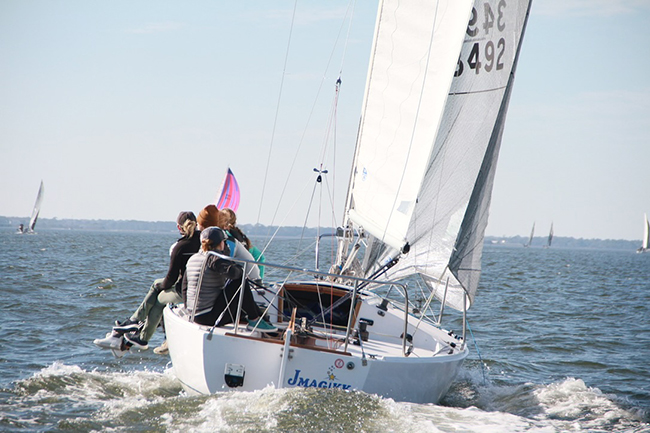
Katie Williamson didn’t grow up trimming sails or calling wind shifts. She was raised landlocked near Charlotte, North Carolina, with a respect for the water. Her entry into sailing unfolds more like a beach read than a traditional salt-tinged sea story: a summer invitation from her brother and sister-in-law to live aboard their sailboat in Charleston while she was in college, a handsome yacht broker two docks down, and a beautiful cruising sailboat that changed everything.
She was 21. She fell in love—with sailing and Greg, the sailor who would become her husband. They went out on the boat every day. But here’s the thing: she didn’t stay on the cushioned, romantic side of the sport. She leaned straight into the edge of it.
“I loved sailing from the get-go. I didn’t want to just sit back with a glass of wine and let Greg do all the work. I wanted to learn everything about it,” Williamson says. “When the boat really starts to move, when things get tuned in—it’s adrenaline. Being on the edge of danger is kind of fun. There’s nothing like it.”
That appetite for intensity makes sense. Williamson was an athlete long before she was a sailor, a competitive cheerleader in high school and at Appalachian State. She had the mindset before she had the skill set. Sailing gave her the opportunity to exercise both.
She learned quickly, obsessively. Eventually, she found her way into “Women on the Water,” started by her friend, Jessica Koenig, through Charleston Community Sailing. This was a mentor-driven program that stripped sailing down to its basics on small boats and built confidence from the keel up. Women rotated boats and roles, sailing multiple times a week, learning not just how to sail—but how to help each other and how to lead.
That program became the gateway. In 2018, after about a year of intense sailing—Williamson found herself staring at an unexpected opportunity. Fellow sailor, Amy Woodard, had secured a coveted entry into the J/24 World Championship, the pinnacle of the one-design fleet, drawing nearly 80-100 boats from around the globe. As a Community Sailing–sponsored effort, applications were opened to all women in the program. Williamson hesitated. She worried she lacked the experience of other applicants. Still, she applied—and got the call.
What followed was a baptism by fire: heavy wind, international competition, mechanical breakdowns, and a hard-earned mid-fleet finish. It was her first taste of elite racing—and she was hooked.
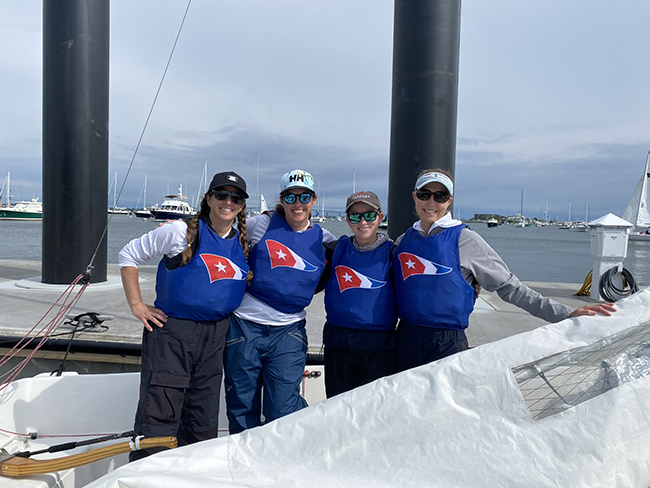
Today, Williamson races with an all-women J/24 crew that she’s been part of since that race, with Woodard as their skipper. They bought their boat, J-Magikk, together in 2020. Williamson, who was pregnant at the time, jokes that she served as “financial sponsor” that season. The team, ranging in age from mid-30s to 50s, sails locally and nationally, and participates in Charleston Race Week every year.
They are meticulous. Spreadsheets for schedules. Delegated roles. A boat where everything has a place. On the water, things can get intense—but they are good at leaving that there. Off the water, they brunch, they laugh, they show up for each other. Even if it’s been a minute between races, they feel like a well-oiled machine. Muscle memory kicks in. The stereotype of cattiness never materialized. “I’ve had more issues with male egos than I’ve ever had with women on our boat,” Williamson says. And that’s where the fairytale sharpens into reality.
Despite progress, sailing remains deeply male-dominated. Mixed crews often relegate women to the rail or the pit. Some regattas still require female skippers as a “handicap,” as if presence alone is a concession. In Charleston, only one yacht club allows women to join as full members. Incidentally, it is there, at the Charleston Yacht Club, where Williamson recently took over the role of Commodore.
Williamson’s team races amateur—and they race hard. Often, they are one of only a couple of all-women boats even at national races or Worlds. They line up with everyone else. “We like racing against the guys,” she says. “There’s no job on our boat that requires a man to do it.”
That autonomy is everything. On an all-women crew, every role is earned, learned, owned. Trim. Twing. Tactics. Bow. Helm. Weight placement. There’s no default, no sidelining. And sometimes, yes, they joke about wishing for “a big boy on the rail” on heavy-air days—but they manage. Often with weight to spare at official weigh-ins, where male crews strip down to make limits.
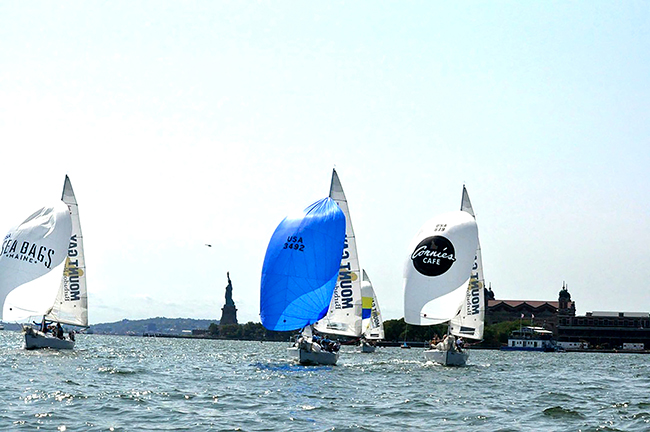
Charleston Race Week offers them variety. Unlike longer, government-mark courses, Charleston provides windward-leeward racing—pure, technical, demanding. It’s practice that matters. It’s local. And it’s where the “girls,” as they’re affectionately called, “look to whip up on the boys,” she laughs. “Girls” who have incidentally made the podium for a top 3 finish in the last several years.
Williamson balances it all—racing, motherhood, co-owning Ashley Yachts—a yacht brokerage with her husband, and now as Commodore of the Charleston Yacht Club. She prepares physically, too, especially after knee surgery last year. Sailing is unforgiving. Strength matters. Awareness matters. So does taking up space as a woman.
That’s her message now, especially for younger female sailors. “Girls don’t just crew anymore. They skipper. They coach. They lead. Sailing programs are hiring elite female coaches.” Visibility is changing the tide.
Williamson didn’t grow up imagining this life. She stumbled into it, fell hard for it, and then fought for her place in it. She’s happiest when the boat heels hard, the wind picks up, and there’s no edge left but forward.