The Sound of a Nation
07 Mar 2026
march-april 2026
Written By: Liesel Schmidt
Jazz, Charleston, and the rhythms that shaped America
by Liesel Schmidt
As chaotic as jazz may sound to the untrained ear, there’s purpose in the disorder, design in the unruliness. Jazz is communication—a give and take, a question and an answer, a quip and a reply. In its way, it is a metaphor for what lies at the heart of America. And as the nation approaches its 250th anniversary, the annual Charleston Jazz Festival, presented by Charleston Jazz, serves as a reminder of history—not only of how a nation came to be, but the influences of its people on its culture and, particularly, on its music.
“Jazz stands as one of the clearest reflections of the broader American story,” says Grace McNally, Marketing and Communications Manager at Charleston Jazz. “It is America’s original art form—born in cities like New Orleans and Charleston from African American communities that blended African rhythms, European harmonic traditions, blues, spirituals, and lived experience into something entirely new. From its very beginning, jazz has embodied the country’s most aspirational ideals: freedom of expression, individual voices within a collective, and the creative power of cultural exchange. Jazz is built on improvisation, dialogue, and swing,”
McNally goes on. “Musicians listening deeply to one another, responding and finding unity without erasing individuality. In that way, it mirrors democracy itself: imperfect, evolving, and dependent on collaboration and trust. At the same time, jazz tells an honest story of America’s struggles, particularly the resilience and brilliance of Black Americans who created beauty and innovation in the face of injustice.”
Consequently, jazz has experienced changes over the last century, absorbing cultural influences and reacting to social change. And rather than stay isolated to the American people, it has achieved global reach, standing as what McNally describes to be a symbol of American creativity and possibility, connecting people across borders while remaining deeply rooted in its origins. “It reminds us that our national identity is shaped not only by where we’ve been, but by our ongoing capacity for innovation, resilience, and shared expression,” she says.
That very same statement could be said of Charleston, where Gullah Geechee traditions played a key role in the rhythmic and cultural aspects of jazz’s development. Groups like The Jenkins Orphanage Band, one of the earliest and most influential jazz ensembles in the country, have become a shining example of how music education, access, and community investment can influence the lives and culture of an entire nation.
Such a legacy is not confined to static history books or archival recordings. In Charleston, jazz’s instrumental role in the American story continues to play out today—most notably through Charleston Jazz, a non-profit arts organization dedicated to cultivating jazz through performance, education and outreach while celebrating its history.
“What began as a vision shared by local musicians has become the Lowcountry’s leading presenter of jazz, reaching more than 14,000 people annually,” McNally notes.
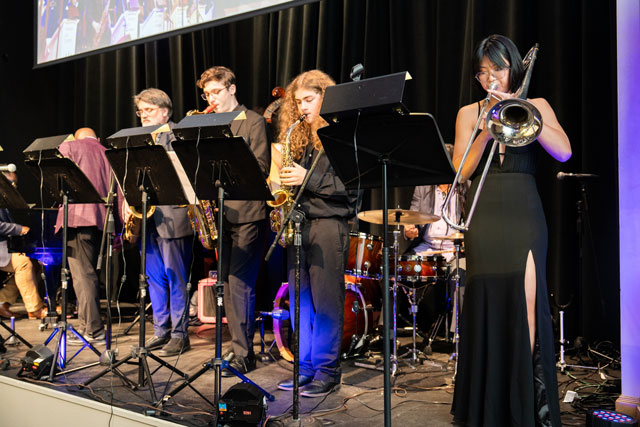
In addition to the Charleston Jazz Orchestra, Charleston Jazz presents the annual Charleston Jazz Festival, which features internationally renowned jazz artists along with Charleston’s own, illustrating how jazz thrives with global influence and local tradition working in concert.
“This commitment to the future of the art form is reflected in performances by Charleston Jazz Academy students during the festival, alongside robust educational initiatives such as masterclasses in public schools led by the Herlin Riley Quartet and Danilo Perez,” McNally says. “Through performance, education, and community engagement, Charleston Jazz honors the legacy of the Jenkins Orphanage Band not as history alone, but as a living blueprint—one that continues to inspire creativity, opportunity, and cultural connection for generations to come.
“A central theme guiding our programming is the idea that jazz is community,” McNally continues. “In partnership with Spoleto Festival USA, we are continuing our Jazz = Community initiative, which emphasizes connection, dialogue, and shared experience both on and off the stage. Jazz has always thrived in communal spaces—clubs, neighborhoods, schools, and places of worship—and our programming reflects that history by creating opportunities for meaningful engagement beyond performance alone—through listening, learning, and coming together as a community.”
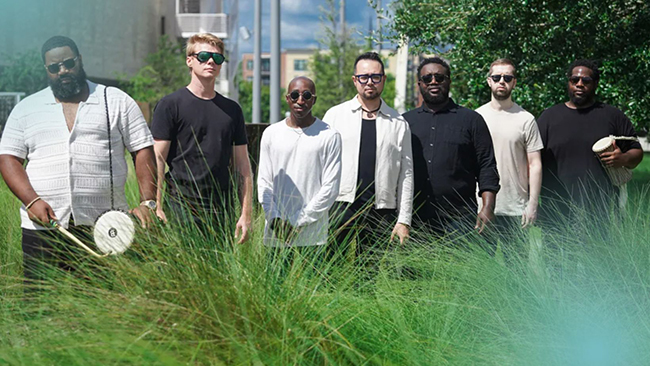
Key artists this year include Panamanian pianist/composer Danilo Pérez, performing with the Charleston Jazz Orchestra, and Cuban pianist/composer Alfredo Rodríguez—both of whom draw on Afro-Caribbean and Latin American influences; jazz fusion guitarist Al Di Meola; Charleston’s own Gullah Collective; and the New Orleans-based Herlin Riley Quartet.
“Each of our festival headliners strongly aligns with the idea of America at 250 years because they collectively reflect the diversity, resilience, and continual evolution that define both jazz and the American story,” says McNally. “Together, these artists embody jazz as a living art form: one that honors the past, responds to the present, and looks toward the future.”
The 2026 Charleston Jazz Festival runs from April 13-21. For more information, visit charlestonjazz.com or call 843.641.0011.