A City in Stride
08 Mar 2026
Inside the Let’s Run Charleston community that helps carry Charleston across the Cooper River Bridge
March-April 2026
Written By: Daria Smith
Inside the Let’s Run Charleston community that helps carry Charleston across the Cooper River Bridge
by Daria Smith
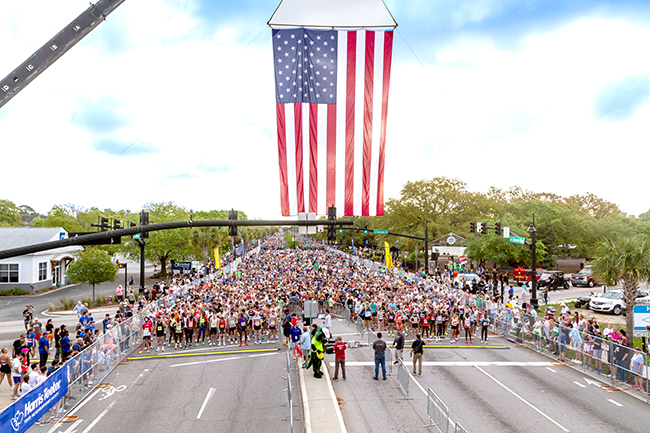
Just after dawn on Saturday, March 28, 2026, Charleston will gather for a ritual it has practiced for nearly half a century. The starting horn of the Cooper River Bridge Run will send 38,500 runners and walkers surging forward, sneakers striking pavement in uneven rhythm as Mount Pleasant gives way to the long, steady climb of the bridge. The race generates an estimated $33 million in a single weekend, stands as the third-largest 10K in the country behind the AJC Peachtree Road Race and the BolderBOULDER 10K, and continues a story that began in 1978. In 1994, Oprah Winfrey even counted herself among the Bridge Run’s participants.
Yet for many of the people lining up this spring, the bridge is only part of the story. The deeper meaning unfolds in the months leading up to race day, on humid weekday evenings and early weekend mornings, when Charleston’s run clubs transform training miles into a communal endeavor. On any given run with the Let’s Run Charleston Run Club, the group stretches across blocks, a moving cross-section of the city. First-timers jog beside seasoned runners. Conversations drift from pacing strategies to dinner plans. What began as a modest idea in August 2023 has redefined how many people experience both running and Charleston itself.
Co-founder Ellie Dickinson, a personal trainer and run coach who had recently moved to town, initially set out to train for the Kiawah Half Marathon and build community through running. She met co-founder Bradley Carter, a personal trainer and wellness coach, at HYLO, the gym where they both worked. Together, they recognized an opportunity to move beyond the gym’s walls, creating a run club designed to bring people together, particularly within Charleston’s 40-and-under crowd.
Workouts run year-round every Tuesday, Thursday, and Saturday, with meeting times and locations shared weekly on Instagram (@letsrunchs), making it easy for anyone to show up, no sign-up required. Beyond weekly miles, the group also hosts events, including a recent collaboration with Tidewater, a private members club, that paired a group run with coffee and a live DJ set from Grounded Grooves, known for its house music day parties, on Sightsee Shop’s patio.
“Our first run was a lot bigger than we initially anticipated,” says Carter. “We ended up with 60-70 people.” By the spring of 2024, attendance had swelled to 150-250 runners at a time, a surge that mirrored Charleston’s broader embrace of running as a social outlet.
In the years following the pandemic, run clubs surged nationwide as people yearned for in-person experiences away from screens after months of isolation. Part of the appeal of run clubs lies in accessibility, unlike private clubs or nightlife-driven social scenes. “It’s free. Anyone can come. It doesn’t matter how fast you run, and it’s truly welcoming to everyone,” Carter says. For Dickinson, the inclusivity carried personal weight. “A lot of people our age don’t drink much,” she explains. “They’re looking for something that brings people with common interests together, something that doesn’t revolve around drinking.”
In Charleston, the Cooper River Bridge Run anchors a search for connection. More than a race, it functions as a civic gathering point. “It’s a really cool moment for people at all levels to come together and achieve a common goal, even though everyone is running their own race,” Dickinson says. “It’s our one big attainable race. It’s not a half, it’s not a marathon, it’s something anyone can train for and do.”
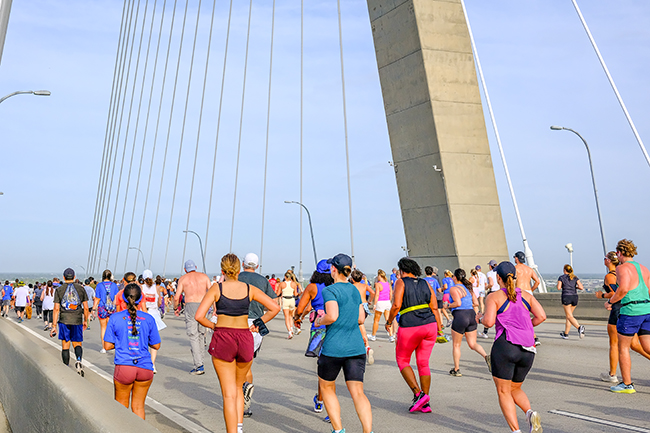
Carter sees it as a mirror of the city itself. “It is the definition of Charleston,” he says. “Charleston loves to raise money, get together for a good cause, and drink, so when all three of those come together, it’s pretty special.” From the starting line in Mount Pleasant to the finish along King Street, the route transforms into a corridor of cheers. “It’s our New York marathon,” Carter adds. “Everyone starts and finishes at the same place, and everyone receives the same amount of love no matter how fast run.”
As spring approaches, Let’s Run Charleston sees a familiar pattern. “Everybody wants community to train,” Dickinson says. “When you’re trying to accomplish something difficult like training for a race, it helps to have people who can commiserate and hold you accountable.” Carter often sees runners surprise themselves during group runs, moving faster than they expected or rediscovering a sense of joy that had slipped from solo miles.
Collective momentum crests on the bridge itself, where the race reveals its emotional core in a steady, unrelenting climb. The ascent demands resolve, a chosen difficulty many adults rarely seek but deeply crave. “It feels like you’ve reached a mountaintop,” Carter says. “The first part of the bridge run is really tough. Once you’re at the top of the bridge, you get to see a breathtaking view of Charleston and thousands of people around you, you hear the DJ, the cheers, the excitement… It’s a surreal experience.”
From there, the course coasts downhill toward downtown, inertia carrying runners forward. Crossing the finish line becomes a simple, powerful accomplishment, a reminder that hard things can still be done, and enjoyed, at any pace.
“There’s something that gives you chills, just seeing everyone out there cheering each other on,” Dickinson says. “Something you don’t have to do but you get to do.”
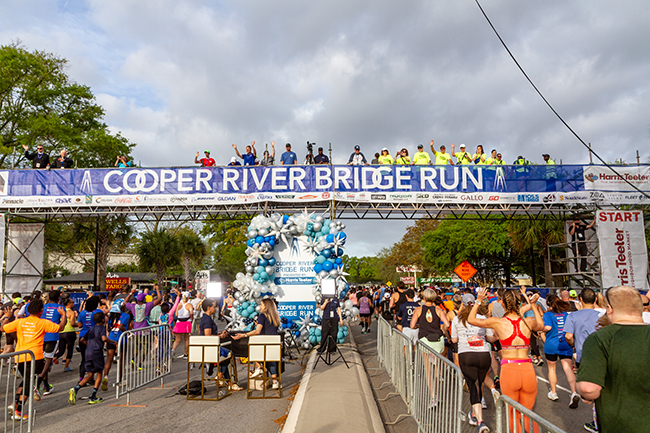
Increasingly, the pull of a hard-earned finish and a city that turns out to celebrate draws runners from far beyond the Lowcountry. The Bridge Run has become a destination race, part of a growing trend of “runcations” that blend fitness with travel. “Running through Charleston and taking in the architecture is one of the best ways to experience the city,” Carter says. In late March, Charleston offers a seasonal reprieve. “For people to come defrost, race, have fun and enjoy themselves after.”
Yet for locals, the impact lingers beyond the weekend. Crossing the finish line often marks the beginning of something rather than the end. “After people do a race and accomplish something together, it makes them want to keep coming back and keep chasing that feeling,” Dickinson says.
The Cooper River Bridge Run has endured for nearly five decades because it continues to evolve while holding fast to its core promise: a unifying moment, open to anyone willing to show up. As Dickinson puts it, “It’s a chance for people to connect through a shared experience that feels larger than themselves.”
On race morning, as the sun lifts over the harbor and the bridge fills with motion, the promise of connection forged through challenge comes into focus. Thousands of individual journeys merge into one collective crossing, carrying Charleston forward together, one step at a time.