Lowcounty Gatherers
05 Jan 2026
Celebrating those who plant, cultivate, harvest and haul
Charleston Living Magazine January-February 2026
Written By: by Pamela Jouan | Images: Photos Celeste Joye Photography; Dogpatch Farmstead; Growfood Carolina; Pamela Jouan
If you want to understand the spine of human history—what truly binds us together—start with an old anthropology textbook or a well-thumbed world history volume. They’ll remind you how the earliest civilizations formed community around the simple, profound acts of growing food and pulling sustenance from the water. Open the Bible at random and you’ll see it there too: fishermen doing the heavy lifting, physically and spiritually, shaping a history that still guides us.
That ancient communion with the earth—casting nets, tending seedlings, feeding others—remains the quiet thread that ties us together: sustenance. In the Lowcountry, we are blessed with abundance, yet none of it is guaranteed. Not the fish in our waters. Not the fertile soil that has nourished generations.
Our gatherers—those who plant, cultivate, harvest, and haul—are the region’s unsung heroes. Fishermen adapting to shifting tides and species with an eye toward sustainability. Farmers working small acreage with big vision, determined to steward the land for those who follow. And the organizations helping them streamline, innovate, and endure. Let’s celebrate them.
Abundant Seafood
More than a fairweather friend
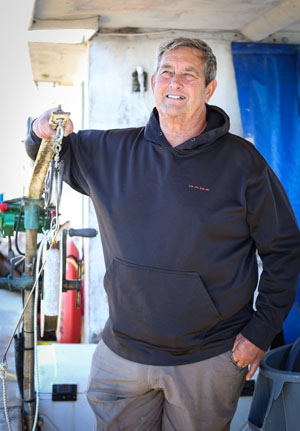
Mark Marhefka has been doing this long enough that you can see waves reflected in his cerulean-blue eyes, even when he’s on land. He’s currently inspecting his 40-year-old boat, the Amy Marie. Since 1988, she’s been both vessel and companion, held together by fiberglass and faith. “She’s like a person,” he says. “Things come loose at the seams, and you patch them up and keep going.” That’s the story of Abundant Seafood: resilience, adaptation and a deep, abiding respect for the ocean.
Mark is the product of a Florida fishing family. He made his way across the Copper River bridge in the late ‘70s when Mount Pleasant was nothing more than a tangle of fishing boats. Much has changed since then—and just as much has stayed the same.
Back then, he was heavily involved in fishery management, working with the Department of Natural Resources to help inform their research programs that monitor fish and other marine life, also called MARMAP. But the seas have changed. Warmer waters, shifting fish populations, dwindling commercial fleets—he’s seen it all. “Everyone thinks the ocean is full of fish,” he says. “It’s not. I see us doing the same management to the ocean that we were doing 40 years ago, and it’s not getting any better.”
Call it climate change for messing up spawning patterns, rising temperatures for pushing the fish further into deeper waters. He’s catching less and still having to share that with the recreational fishermen. But still he persists, mending his boat, his nets, and strengthening the bonds between people and the waters that feed them. Educating chefs about lesser-known and underutilized fish to cook that have now become staples on their menus and starting Abundant Seafood in 2010 as a way to connect people directly to the source, one fresh catch at a time. “Because when you have a great ingredient, and you know it’s been caught responsibly, you don’t need anything more than salt and pepper.”
At 64, Marhefka measures his legacy not in catch totals, but in connection. “At the end of the day, I can say I fed people—I was able to bridge that gap between a public resource and give them a good protein and show them what good fish is really supposed to taste like.” Follow @abundantseafood for details on fresh fish pick-ups.
Closing the Loop
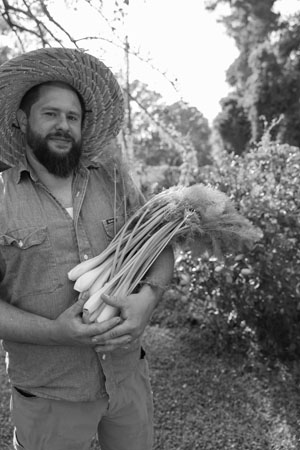
Casey Costa of Dogpatch Farmstead
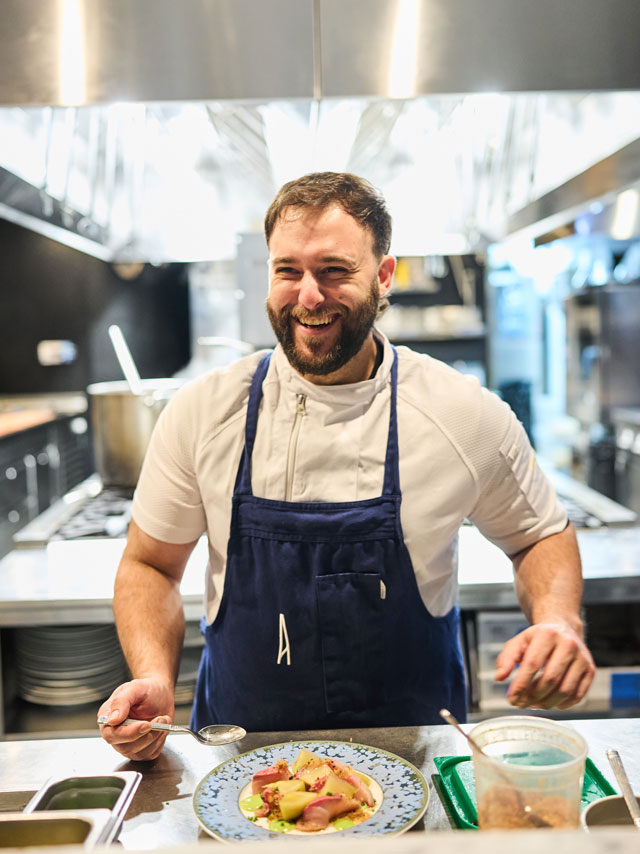
When Casey Costa started going down the rabbit hole of homesteading, incorporating all those skills of “preserving, salting and curing,” that he was already doing in the kitchen, he knew he could be self-sufficient. He credits his grandfather for planting the farmer bug long before he knew it was there—an Italian immigrant who kept a prolific garden and cooked with instinct. But it wasn’t until Casey’s early culinary career took him across the country that the seed fully sprouted.
A move to Napa Valley, California, allowed him a firsthand look at what a small, intensely productive farm could yield. French Laundry’s farm was a turning point: the precision, the small scale, the intention behind every bed. “I was approaching 30—thinking about marriage, buying land, and the kind of life I wanted to build—I wanted to diversify. That’s when Casey realized his culinary skills and his dormant farming instincts were quietly intertwining.
What sealed it was access. Chefs can be intimidating to approach, but Casey already lived in kitchens. The idea of building a tiny farm that fed directly into the restaurants he worked in—and the chefs he bumped elbows with at events and around town—suddenly felt obvious. After returning east, working a full produce season on a New Jersey farm, managing a butcher shop-slash-slaughterhouse, observing Blue Hill’s hog program, and finally relocating to Charleston, he and his wife bought property in Adams Run, South Carolina. Post-COVID, he cleared land, built a greenhouse, and slowly turned two acres into Dog Patch Farmstead.
He calls it “closing the loop”—a near-permaculture system where water runoff and kitchen know-how all feed each other. It’s a lifestyle as much as a farm, one rooted in “nutrient density,” homeschooling and self-reliance. And he believes deeply that if more people operated on this micro-scale—hundreds of small acre farms instead of monolithic agriculture—communities could feed themselves, trade among one another, and weather disruptions like diseases and pests with conversation.
Today, from roughly sixty 20-foot beds, eight 60-foot beds and a 65-foot greenhouse, Casey produces quick-turnover crops for Cannon Green, where he works, Veggie Bin grocery store downtown, and a tight circle of local chefs. His winter yields include lettuce mixes, baby onions, microgreens and plenty of tender baby bok choy—small things that together tell a much bigger story. Follow Casey @dogpatch_farmstead
Growfood Carolina
The little food hub that could
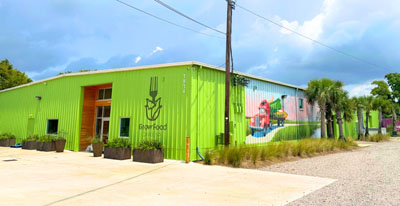
On any crisp January morning, the Growfood Carolina warehouse is awash in color. Pallets of citrus sunshine—zippy Meyer lemons, blushing grapefruits, and plump satsumas—wait to be distributed. Purple daikon and blood-red beets vie for attention, while lumpy sweet potatoes tumble into squat boxes. Brassicas like turnips and cabbages sit beside inky green collards. By late February, a growing hum of anticipation for strawberries fills the space. Seasons arrive by the truckload, shepherded in by farmers who pull up to the loading dock nearly ten times a day.
In the conservation world, GrowFood Carolina Director Benton Montgomery likes to explain the organization’s role simply: the Coastal Conservation League, their parent organization, plays defense; GrowFood Carolina plays offense. While the Conservation League protects land, water, and natural resources, GrowFood Carolina pushes opportunity back into rural communities—turning conservation into a living economic engine. Protect the land, then strengthen the people who depend on it.
The Conservation League launched its Food and Agriculture Program in 2007 with a clear mission: protect South Carolina’s small, family-run farms. The need was urgent. From 1992 to 1997, the state lost more than 400 acres of rural land per day to development, ranking among the nation’s worst for farmland loss. Farmers weren’t selling because they wanted to; many lacked the infrastructure and market access required to stay competitive. When a developer came calling, they often had no real ability to say no.
GrowFood Carolina was created to change that. By building a food hub, the Conservation League aimed to tap into the strength of small-scale agriculture and turn it into a force for rural economic revival. The goal was straightforward: if small farms could increase production, access stable markets and move their products efficiently, they could stay on their land for generations.
In 2011, GrowFood Carolina opened its doors in a modest Charleston warehouse. From those early days serving just five producers, it has grown to support more than 85, offering sales, marketing, logistics, warehousing, and distribution services once available only to large industrial farms. Their wholesale network now includes Charleston restaurants, major retailers like Whole Foods and Harris Teeter, and institutions such as the College of Charleston. To date, GrowFood Carolina has returned nearly $5.5 million directly to farmers. In addition to their Charleston homebase, they trade with Freshlist—Charlotte’s fresh food hub, Swamp Rabbit Cafe and Grocery in Greenville, and the Gullah Farmers Cooperative Association in Beaufort County.
Today, operating from a larger home on Harmon Street, GrowFood Carolina continues to evolve. The pandemic accelerated their direct-to-consumer CSA model and expanded their food-access work, supplying everything from Head Start programs to food banks. Now farmers can take pride knowing that a humble carrot might end up in a CSA box, plated at FIG, or donated—always fresh—to a community that needs it most. Find out what’s in season @growfoodcarolina
Super Mushroom Bros
How one grower found his way back into the world
When Robert Schulz started Super Mushroom Bros, he created not only a viable business but meaningful connection. After years spent flipping houses, often working alone inside half-gutted rooms with a podcast playing in the background, he stumbled onto a conversation with famed mycologist Paul Stamets, and it lit a spark. Mushrooms had always interested him, but now they felt like an invitation. The very next day he wandered into his backyard and discovered nearly ten pounds of chanterelles thriving under his mature oaks. “I took it as a sign,” he says.
Schulz began learning about the fungal kingdom the same way he had learned carpentry, plumbing, and electrical work—by diving in headfirst. He found online communities of small-scale growers and started crafting his own sterilizers and fruiting chambers inside his house. The ingenuity thrilled him. “It was hugely fun and validating,” he says. “All the little odd jobs from my past made me competent enough to take on this new challenge.”
He had no restaurant connections, no formal background in agriculture, and no guarantee anyone in Charleston wanted gourmet mushrooms. What he did have was the willingness to start small. His first farmer’s market yield was half a pound—gone in five minutes—followed by four hours of sitting at an empty table so the market managers would know he was committed. Slowly, he built relationships: curious customers, local market organizers, and eventually chefs willing to try his oysters, lion’s mane, and seasonal varieties. “I went to the nicest restaurants in town first, hoping something would happen.” As it turns out, that was the way to go. Right off the bat, his mushrooms found a home on the menus of FIG, Circa 1886 and Slightly North of Broad.
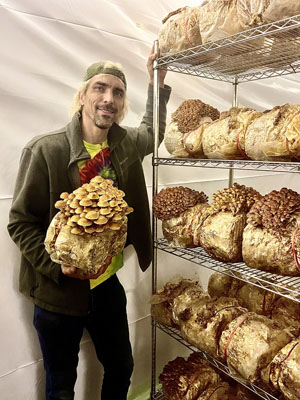
Super Mushroom Bros outgrew Robert’s home a few months ago and now fills a warehouse he built himself. As he moves from room to room—warm, filtered air courses through thick vents to keep the environment clean—he walks through each step of the process with the ease of someone who’s lived it. In one corner sits what looks like a repurposed clothes dryer. “This is where I mix the substrate with the grain spawn,” he says, looking at some shelves. “The spawn goes into the bag, and then I use this old dryer to mix it real good.” Innovation growing right alongside the mushrooms.
Here, Schulz can triple his production. Yet the heart of the business is still local. Mushrooms are fragile; they simply don’t survive the industrial supply chain the way grocery store button mushrooms do. That fragility has created a niche for growers like Schulz—small, nimble, hyper-local growers supplying chefs who want the freshest product possible. Alongside fresh mushrooms, he now crafts dual-extracted supplements like turkey tail and reishi, inspired by a rising cultural hunger for natural, functional foods.
What started as a personal experiment has become part of a wider movement. As Schulz sees it, people need to reconnect—to food, to land, to each other. “The more connected we seem to be, the more alone we become. We need to give people purpose, a goal, like growing our own food. It’s a form of therapy.” Industrial agriculture may feed millions, but it has also distanced us from the source of our nourishment. In building a small mushroom farm from the ground up, Schulz found his own way out of isolation: a cottage industry where craftsmanship matters, where learning to come out of his shell meant meeting chefs at their back doors, and where growing something humble—but not industrial—helped him rediscover community in its most human form. Find out where to get his mushrooms follow @supermushroombroschs or go to supermushroombrosllc.com