salt life: From the Salt Marsh to the Table
03 Jul 2026
Bowen’s Island oysters form a Lowcountry legacy
July-Aug 2026
Written By: COLBY DENTON
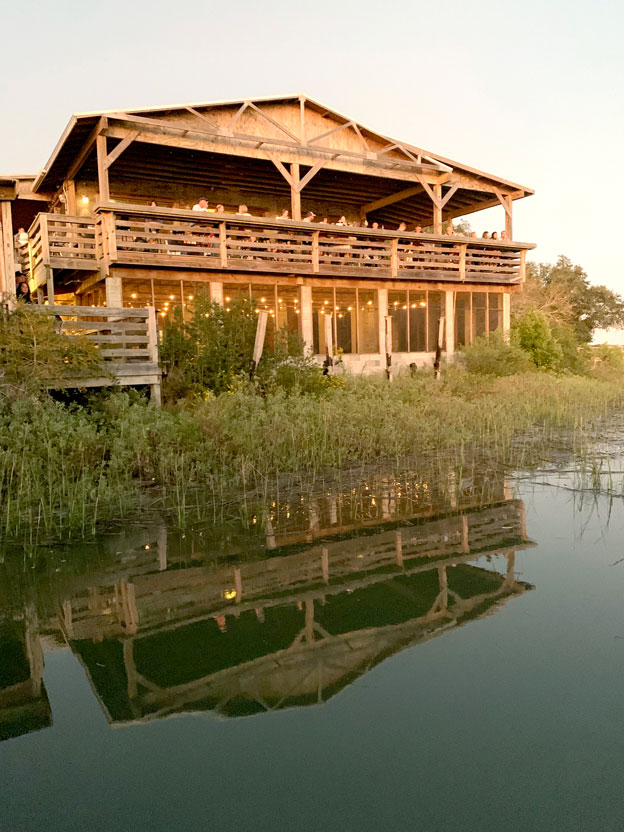
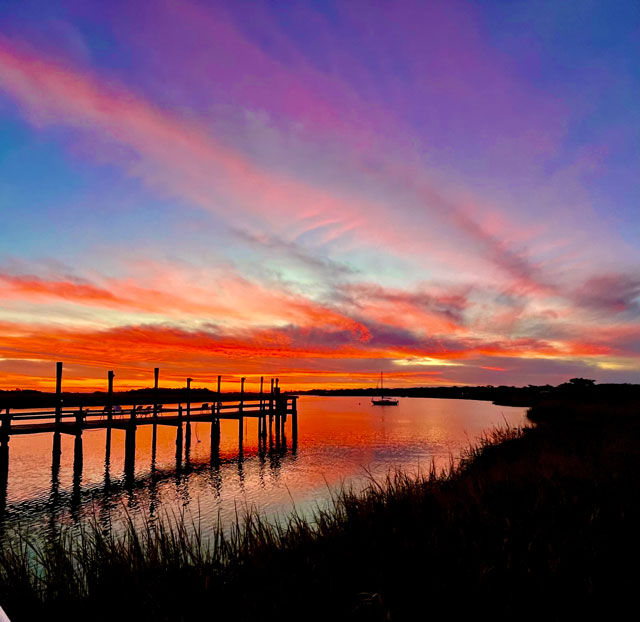
Across the marsh just before Folly Beach sits a tiny island with a restaurant that’s become a Lowcountry icon: Bowen’s Island. Its family-run atmosphere and fresh, local oysters have cemented its place as a critical stop on anyone’s Charleston checklist.
Oysters are as “Charleston” as she-crab soup and Rainbow Row, and those harvested in the tidal creeks surrounding Bowen’s Island are carefully selected and harvested before they wind up on your plate at the restaurant.
Founded in 1946 as a fish camp by Jimmy and May Bowen, Bowen’s Island has a culture permit giving them access to parcels of land where they alone can harvest oysters. And no one knows how to harvest them better than Bowen’s Island oyster picker Adrian Wallace.
“My family grew up on the water, so crab, shrimp, fish, oyster, whatever was out there, we’d catch it,” he says.
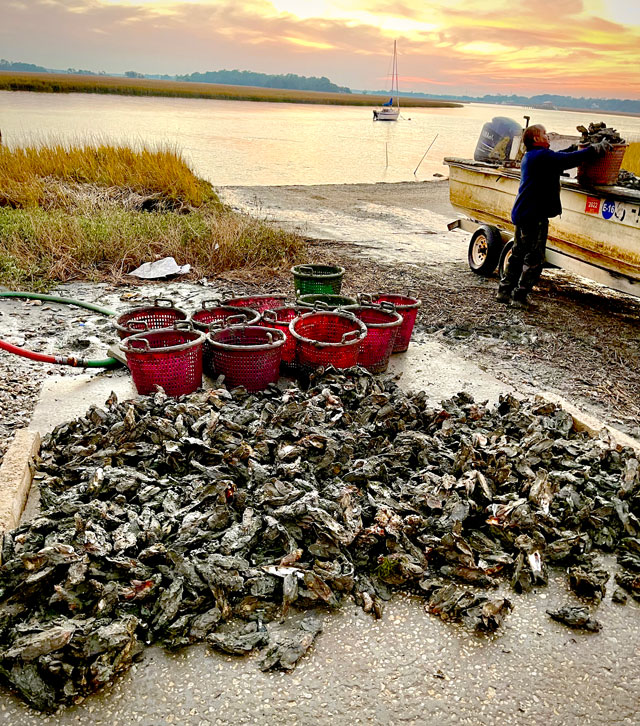
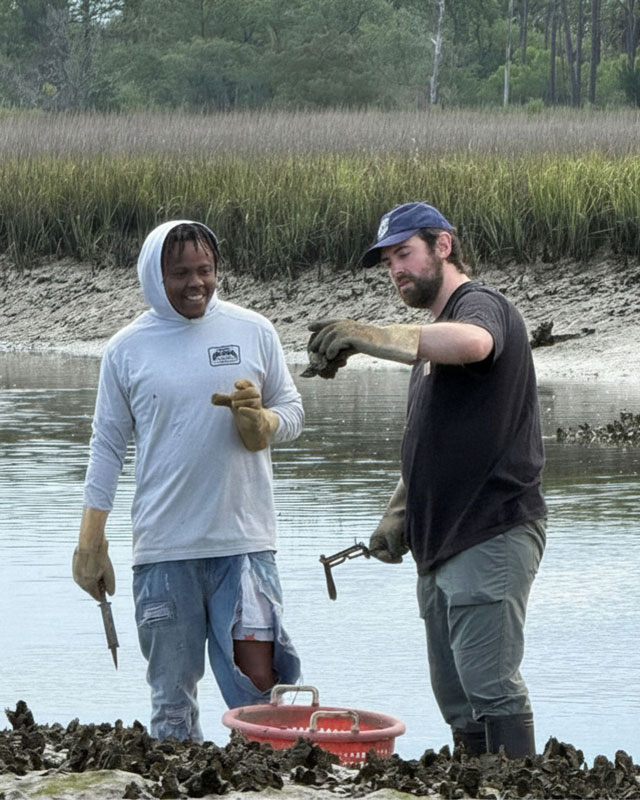
Wallace has worked for Bowen’s Island for eight years. He was invited by his cousins, who are also adept at harvesting the salty bivalves. Growing up on nearby Sol Legare Road, he already had an affinity for picking oysters from Folly Creek and Mosquito Beach, but said his cousins showed him how to be more selective.
We set out one Sunday morning with a dreary sky, which in hindsight was preferable to full sun. Oyster picking is no easy task for the uninitiated. For starters, all “pickers” need a boat to access the mudbanks containing them during low tide. Tall, waterproof boots will keep you dry as you slowly traverse your way to a suitable spot. My big rubber boots came in handy. As we plucked bushels, I had to be super careful not to step on a “softer” spot in the pluff mud, which I did once and almost didn’t get my foot back!
Charleston oysters grow in clusters, and as Wallace points out, larger, healthy-looking bushels are your best bet for making a suitable selection. Just like the boots, thick gloves are a necessity, this time to prevent cutting your hands on the sharp oyster shells. I’m thankful Adrian had an extra pair of gloves because I would have been up a creek without them. Once you’ve plucked a good cluster from the pluff mud, it’s time to chip off any undesirable shells on the lower portion.
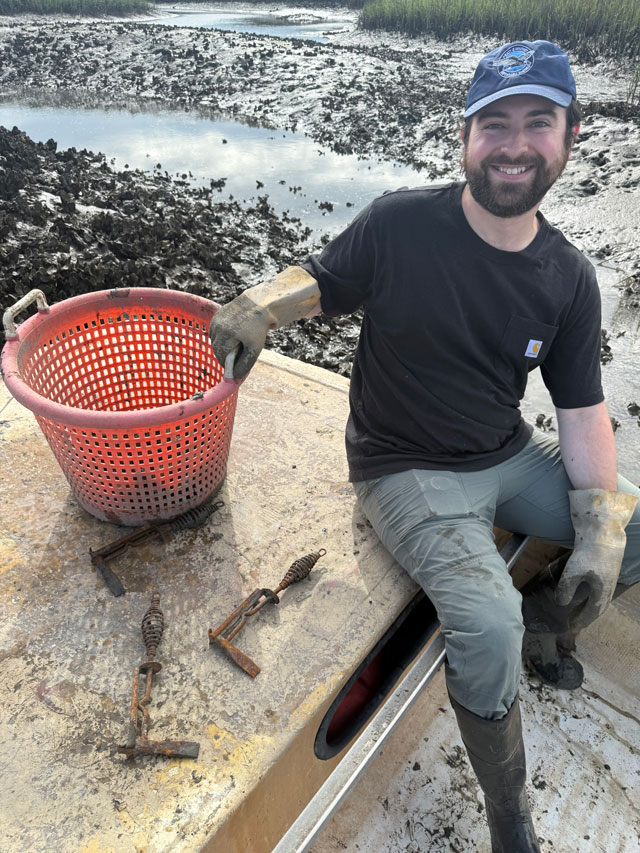
The Bowen’s Island oyster picker’s tool is an aged, iron hammer with a chisel-shaped head that’s perfect for not only knocking off shells but also enduring the harsh sun and salt of the creeks. The goal is to chip off any old, dead, or brittle shells that make up the very bottom of the cluster. I was initially shocked at how simple and effective the tool was. Once the cluster resembles the ones you get at a local roast, it’s ready to go in the basket.
At the end of each workday, Wallace estimates he collects around 25 bushels of oysters. That’s roughly 1300 pounds of oysters!
Following May Bowen’s death in 1990, the community wondered what the future would hold for the iconic restaurant. That’s when May’s grandson, Robert Barber, and his wife LaNelle took the reins and kept the family business booming.
“It’s an honor to inherit something that’s become such a Lowcountry tradition,” Barber explains. “You always meet people who are visiting for the first time, but also countless others who have been coming here for many, many years. As children, on a first date, or for a wedding event. All these great memories have become something of a family trust.” Before taking ownership of the restaurant, Barber— an ordained Methodist minister and lawyer—had degrees from Wofford College, Duke University Divinity School, and South Texas School of Law. Following a day at the office, he would put on an apron and wait tables at Bowen’s Island.
Once harvested, cooking your oysters is the next step, and Barber offers suggestions depending on your level of oyster expertise. For someone trying them for the first time, he suggests steaming them a bit longer until all the shells open. But for the regular connoisseur, he recommends steaming them a little less, so that they are cooked without all opening up, ensuring plump, briny, and juicy oysters full of all that salty, Charleston flavor.
“Either way, the oysters will taste good as long as you don’t overcook them but keeping that flavor contained in the shell is the goal,” he adds.
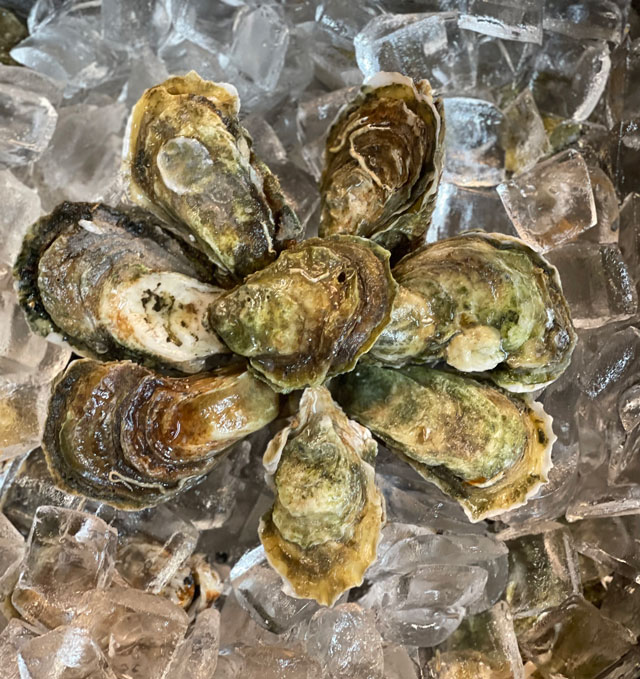
Another cooking method called “scalding” involves boiling the oysters in a full pot of water. They can also be placed on a flat surface over a hot, open fire and covering the oysters in soaking wet burlap sacks.
While there are only a handful of methods to roast oysters, the additional accompaniments for enjoying them are endless, and include hot sauce, cocktail sauce, mignonette, lemon, and even horseradish. For Barber, his family’s special recipe for cocktail sauce is the perfect addition. For Wallace, it’s the tried-and-true Texas Pete®. But everyone agrees that nothing beats the natural flavor of a steamed oyster simply on it’s own.
“There’s a great vibe here at Bowen’s Island,” Wallace said. “We’ve got the best oysters in the world.” The future is bright for Bowen’s Island as Barber says he expects the restaurant to continue to remain under family management. His daughter, Hope Barber McIntosh, discusses plans to fully expand the dining and event options on the island, including new Sunday experiences this summer and fall.
I was honored to be given the Bowen’s Island VIP treatment by Adrian Wallace and Robert Barber, leaving me with an increased sense of appreciation for anyone who picks oysters. I never realized what goes into the process; using that hammer to chip away small and brittle shells, to forge my “perfect cluster” while shin-deep in pluff mud. Yes, it was exhausting, but so rewarding too!
The next time you’re looking for a unique, family-owned place to take your family for local seafood, one that offers unimpeded views of the Lowcountry’s natural beauty, take a turn off the beaten path toward that small island. An island founded on love, dedication, and, of course, fresh seafood straight from Charleston’s own waters.