Talons and TLC
05 Jan 2026
Local birds of prey center encourages birding and conservation through awareness and rehabilitation initiatives
Charleston Living Magazine January-February 2026
Written By: By Colby Denton | Images: Photos Sandy Stolzman Photography; Avian Conservation Center & Center for Birds of Prey
Seeing birds of all shapes and sizes cruising through the sky is an everyday occurrence that most people don’t think twice about. Unbelievably, eagles, herons and hawks are fairly common in our backyards; but what about an owl from the Ural Mountains? Or maybe a crested caracara from South America? It’s the presence of these unique species at the Avian Conservation Center (ACC) in Awendaw that grabs visitors’ attention and demands further exploration into their background, habits—and sometimes— vulnerability as a species.
ACC Vice President and Director Stephen Schabel believes that showing the public just how unique and critical birds are to our environment is one of the first steps in changing behaviors that threaten them.
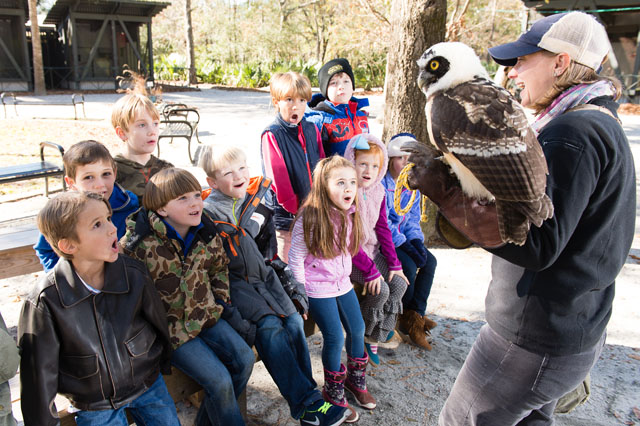
Most days, Schabel leads an interactive bird program at the facility’s outdoor amphitheater giving visitors live demonstrations of a number of species. Most recently, the demonstration includes a Harris’s hawk, a Ural owl, a yellow-billed kite, a burrowing owl and a black vulture. Having a massive raptor fly inches above your head is thrilling for guests, and Schabel says it’s this sense of awe that helps drive home the point that the birds deserve protection.
“The goal of these programs is to talk about what we see in our Avian Medical Clinic, and the problems we see birds encounter in the world that the audience can potentially help solve,” Schabel says.
Founded in 1991, the ACC has worked tirelessly since its inception to identify and address vital environmental issues while providing medical care to injured birds of prey and shorebirds alongside its numerous other initiatives. Initially called the Charleston Raptor Center, a 501(c)3 organization, it was quickly renamed the South Carolina Center for Birds of Prey in 1995 to better reflect its expanded scope of services.
It would become the ACC in 2004 as an umbrella organization to accommodate countless avian services that include the Center for Birds of Prey, Avian Medical Center and South Carolina Oil Spill Treatment Facility.
The most common species seen at the hospital is the barred owl, which is often struck by vehicles. “We quickly realized that simply caring for an injured bird wasn’t fixing the problem. A sick bird is a symptom of the problem,” Schabel explains.
Overall, the ACC sees approximately 1,000 patients per year, with some even making headlines. In early 2025, they admitted an osprey that went viral overnight because it was rescued on Folly Beach by surfboard. Tangled in fishing line the raptor was saved from the surf and transported to the ACC. A photo of the disoriented, bedraggled osprey spread quickly across social platforms, ultimately serving as an unexpected boost for bird-education efforts.
While birds rank among the world’s most formidable predators, they also double as sensitive gauges of ecosystem health. Consider the swallow-tailed kite, a species whose very presence reflects the state of its habitat—habitat that has been steadily declining in South Carolina.
This level of education is parallel to the growing hobby known as birding, with birders being people who observe, feed or photograph birds at home or while traveling. While birders constitute a full bird-centric lifestyle, Schabel says most of the people visiting ACC are “bird enthusiasts.”
“There are so many resources now for people to help birds. A good example is the app eBird, which lets people note when they saw a bird and where. This collects vital data that helps gear initiatives toward conservation,” Schabel adds.
Some of the biggest threats to birds include gunshots, vehicle collisions and discarded fishing tackle. Another major—yet often overlooked—danger is rodenticide, widely used across the country in rat bait boxes to control rodent populations.
Besides offering numerous services, the ACC is also the ideal contact for reporting injured birds. Schabel says that even if it’s a bird they don’t treat at the hospital—like a songbird or duck— they are able to provide contact information for who can.
For anyone eager to support avian conservation, a daytrip to the ACC offers a powerful reminder of just how vital raptors are to the Lowcountry ecosystem. “If people take home just one lesson after their visit, that’s the first step,” Schabel says.
Anyone who encounters an injured bird can report it to: (843) 971-7474. Visit thecenterforbirdsofprey.org for more info.