Wild Roots
05 Jan 2026
The botanical journey of April Punsalan
Charleston Living Magazine January-February 2026
Written By: By Liesel Schmidt | Images: Photos by Sydney Scott; Kim MyIntyre
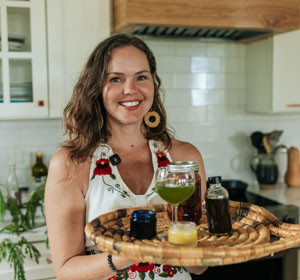
If you’re someone who believes in past lives, it’s easy to picture April Punsalan as an herbalist, a medicine woman or a shaman of some kind in a past existence, foraging plants and berries, making poultices and tinctures. She spent years as a botanist for the U.S. Fish and Wildlife Service, protecting rare and endangered plants. In time, she found a new mission: teaching others to connect with the earth and remember the roots from which they came—as stewards of the planet, harvesters of the earth’s gifts, and tellers of the earth’s tales.
Punsalan’s journey to find her own purpose began as a child, roaming the wild woods near her home in Chesapeake, Virginia. “I don’t have many childhood memories, but something about that land connected me deeply with myself, touching my heart and soul,” she recalls of her time spent wandering what she later came to find out was the Northwest River Natural Area Preserve. “I always felt an incredible sense of magic in those woods.”
It was during her years in high school in Norfolk, Virginia, that Punsalan realized that the magic she’d felt as a child was calling out to her. “I was in computer science and falling rapidly behind when we took a tour of the vocational school and I saw greenhouses and kids planting pansies,” she says. “It was as if time stood still. I went from an at-risk youth to receiving awards overnight once I started horticulture.”
After completing a two-year horticulture program in high school, Punsalan went on to study botany and received her bachelor’s at UNCA and, later, a Master of Science from WCU. Upon graduating, she started a career as a botanist for the U.S. Forest Service—a job that required extensive fieldwork locating and protecting rare plants. She then worked for the U.S. Fish and Wildlife Service, protecting federally endangered plants along the east coast. “I learned about hundreds of native plants, so I could recognize and find rare ones. I started to realize that many native plants were medicinal and edible, and my fascination kept growing. As much as I loved learning, I had to face habitat destruction daily,” she says on her 25-plus years in the field. “Eventually, my soul knew it was time to teach.”
She assumed teaching require more schooling to get her Ph.D. and become a professor teaching ethnobotany. But when she kept hitting dead ends with professors not answering her queries, she gave herself permission to teach what she already knew—which was a lot. “And then, I received a message from my consciousness—call it divine guidance, saying: You don’t need any more schooling—you just need to teach.”
Punsalan founded what was first known as Yahola Herbal School—now Wild Herb Academy. “I wanted to help rekindle the sacred bond between people and plants, because when you learn to cherish wild plants, you naturally protect them,” she says. “And in return, they protect you—mind, body, and spirit. It’s more than learning herbalism; it’s remembering who you are and returning to the wild medicine that has always been there—within each of us and throughout the wildness of nature.”
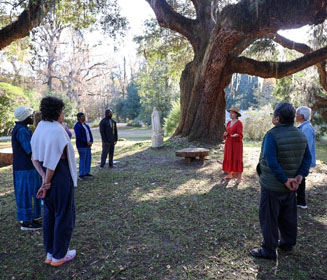
Offering courses in wild apothecary herbal medicine-making, wild herbs and a medical botany apprenticeship, Punsalan passes on her decades of knowledge and passion to others, helping them look at the world with fresh eyes that see deeper than the layers of civilization that have paved over our wild roots.
As busy as teaching keeps her, Punsalan recently wrote “Foraging Wild Herbs: 30 Healing Plants of the Coastal Carolinas,” an in-depth guide for anyone seeking to connect with the wild herbs growing in the Lowcountry and how to identify, ethically harvest and use healing plants. “It was inspired by the deep desire for people to know how to turn to nature for nourishment and medicine, how to live in rhythm with all of nature and to show people that they are nature,” says the Charleston transplant.
“We are attracted to plants for a reason beyond the beauty of their aesthetics,” she goes on. “Most plants are useful, medicinal or edible. There are 4,000 plants in South Carolina, and only approximately ten are poisonous. Out of those ten, probably two are likely to be deadly toxic.”
Naturally, Punsalan has many wild herbs that she feels are her spirit plants: resurrection fern, Spanish moss, Eastern horsemint, Carolina willow and passionflower. Each has a use, a purpose, a meaning. “Plants are storytellers that speak through their form, smell and taste,” she says. “Carolina willow tells you about flexibility with its bendable branches. Common blue violet teaches us that staying grounded to the earth helps to cool the inflammation in our bodies. Pennywort contains a high concentration of antioxidants that protect our brains from degenerative diseases. I always teach students to learn from the plants first before heading to a book.”
Punsalan has lived in Western North Carolina and South Carolina, finding a special love for each in the connections she feels with the people as well as nature. “A perfect Lowcountry morning is going to Folly Beach and watching my daughter and husband surf together, followed by fish tacos at the Crosby Fish Food Truck and relaxing with sandy toes while pelicans fly overhead and dolphins feed in the tidal creek,” she says. “Mornings like that make my soul feel at home.”
BIO
Hometown
Norfolk, Virginia
Education
Horticulture, Norfolk Vocational Center; Bachelor of Science, University of North Carolina at Asheville; Master of Science, Western Carolina University.
Family
Husband, Vasily; daughter, Annarose; four-legged son, Milo
Guilty Pleasure
Popcorn and dark chocolate
Daily Ritual
Kundalini yoga for one hour upon sunrise
Favorite Quote
“When women heal, the earth heals.” - Unknown
Last Book I Read
“In an Easter Rose Garden” by Hazrat Inayat Khan
For more information, visit wildherbacademy.com. “Foraging Wild Herbs” can be pre-ordered online at amazon.com with a publishing date of April 14, 2026.