What Is Art?
02 May 2026
Inside the expanding universe of Beeple Studios
May-June 2026
Written By: Pamela Jouan
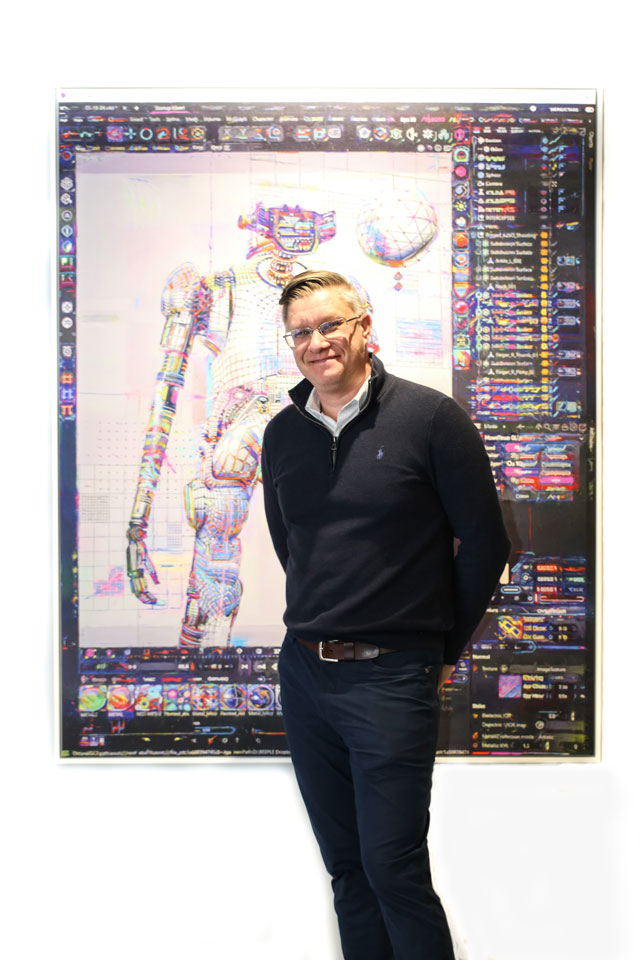
What is art? It’s a question as old as time. It has been asked in the echoey marble hallways of lauded art institutions, screamed on subway walls, whispered in cloistered studios, and debated in loud auction houses. But step inside the sprawling, shape-shifting world of Mike Winkelmann—a.k.a. Beeple—and the question feels less like something to answer and more like something to experience.
Because here, art isn’t static. It moves. It flickers. It flashes. It vibrates. It loops. And then it winks back at you.
Winkelmann’s compound on Daniel Island feels less like a traditional studio and more like a living organism. One half is pure experience: an immersive event space where projections pulse in rapid succession across walls, and a gallery lined with digital art. The other half is the process—the messy, industrious, working part. Studios hum with art in progress: prints, posters, box-like kinetic video sculptures, and robotic figures, while servers blink quietly in all-purpose rooms, guardians of digital secrets. There’s even a woodshop where digital ideas become tangible objects.
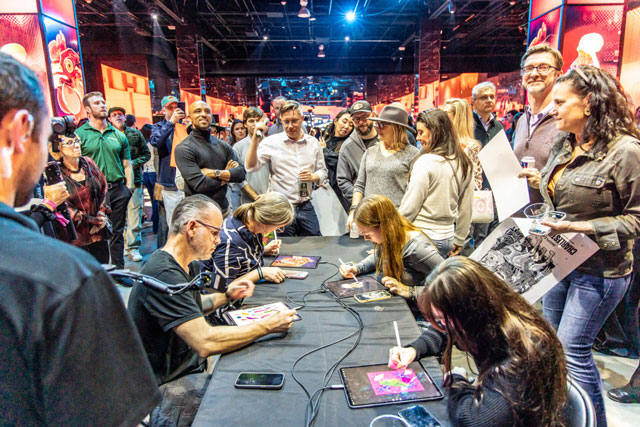
You’re backstage between the pulleys and the gaffer tape, ready to open the curtain and reveal the wizard. And yes, while Winkelmann is both architect and conductor, he’s not just pulling levers to orchestrate art, he’s creating the conditions for it to happen.
His story is not traditional. There was no formal training. He didn’t study painting or sculpture. He didn’t go to Pratt. Instead, there was a computer—arriving sometime around fourth grade—that held the key to everything. “I was like, what can this computer do?”
That curiosity led him to study computer science, initially with dreams of making video games. But halfway through, he recognized a truth: the people who really wanted to make games couldn’t stop doing it. He, on the other hand, couldn’t stop making strange, experimental digital art.
So, Winkelmann made a decision that would quietly inform his success. He would get a practical job—web design—and make art anyway. Not for money. Not for recognition. Just because he had to. Because it was an expression that needed an outlet.
“I’ll never make money on it,” he told himself. “But I’ll put my energy into the thing that’s fun.”
For nearly two decades, that’s exactly what he did. And then the world caught up.
By the time NFTs exploded in the early 2020s, Winkelmann had already built a massive following—millions of people watching his daily postings of digital art. Success, in that sense, wasn’t sudden. It was cumulative. He didn’t need to chase the market; he was there first. But what he’s doing now feels less like capitalizing on a moment and more like reshaping it.
He holds four to five community art shows a year at his facility. They each have a theme, are free to the public, and are increasingly large. They are less exhibitions than experiments. Instead of showcasing a handful of carefully selected works, he opens the door to hundreds of artists. Send a GIF. Send a video. If it fits the theme, it’s in.
The result? Group shows featuring 150 to 200 artists at a time. In a traditional gallery, that would be a logistical nightmare—insurance, shipping, installation, spatial constraints. In Beeple’s world, it’s doable.
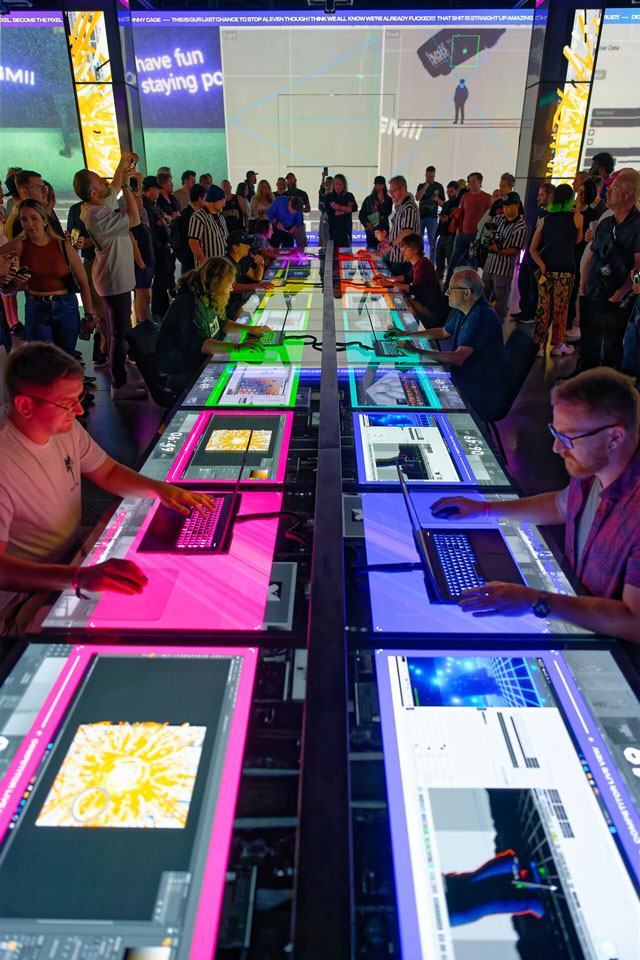
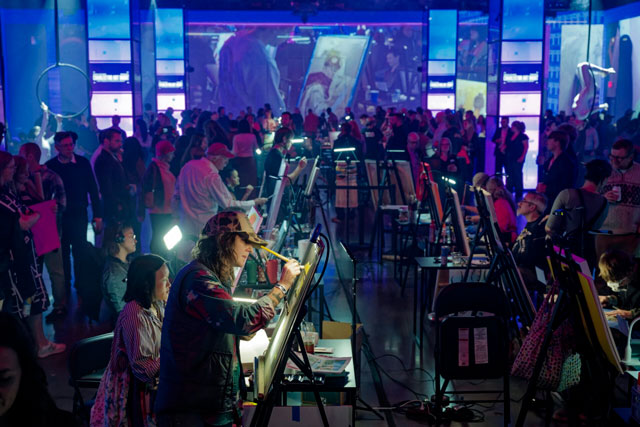
So, why the free events?
Winkelmann looks flummoxed. “I literally don’t know because this is not so much a company as an art studio. We’re just making art that resonates with us, and so the events are an extension of that.”
Winkelmann sees these gatherings as artworks in their own right—requiring design in terms of posters, banners, and invites–creations he makes himself. Every detail is considered to make the experience perfect. “What I’m trying to do is make something that you’ve never seen before. And that is not easy.”
They are also an experiment in how he envisions museums evolving—and yes, museums are starting to take notice.
Directors from MOMA, LACMA, the Whitney, and the Guggenheim have all made recent pilgrimages to his space, curious about what’s unfolding here. Not because Winkelmann has all the answers—but because he likes asking questions. “I want to show them what’s possible in an experiential space and how they could potentially be thinking about programming curated experiences.”
He believes museums are at a crossroads. In a world of shrinking attention spans and infinite digital stimulation, institutions must evolve or risk becoming relics—more like libraries than living spaces.
Digital art, he argues, isn’t being fully utilized by institutions that treat it like static media—looping a single piece on a screen for months. Why not rotate constantly? Why not include more voices? Why not make the experience feel alive?
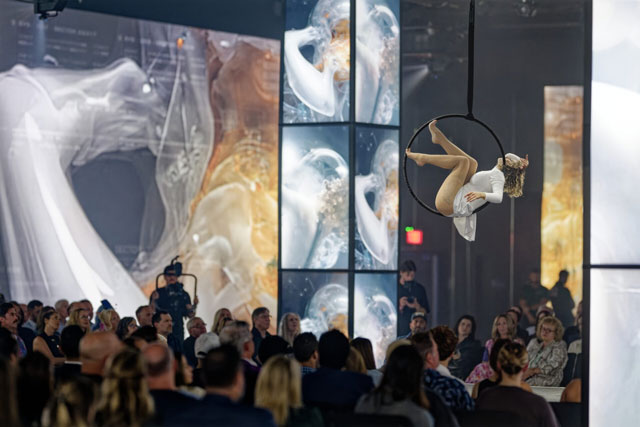
The shift, he suggests, is toward engagement. Toward visceral, immersive experiences that meet audiences where they are now—like with his image-generating sculptures that invite visitors to interact with AI. He creates them with museum settings in mind. And that’s where many of them currently reside.
Of course, no conversation about digital art today is complete without addressing its complications—environmental impact, the rise of AI, the shifting definition of authorship.
Winkelmann approaches these questions with pragmatic indifference.
Yes, digital art consumes energy. But so do traditional art practices—take, for example, casting large sculptures in bronze, or shipping works globally, then storing them in climate-controlled facilities. The difference, he suggests, is often a matter of perception.
More pressing, in his view, is the rapid evolution of AI.
Here, his perspective lands somewhere between optimism and uncertainty. AI is neither savior nor villain—it’s a tool, albeit one of unprecedented power. It will replace some jobs. It will create others. And then probably replace those quickly, too. It will blur the lines between creator and creation in ways we’re only beginning to understand.
“It’s like the camera,” he says—“only multiplied exponentially.” He argues that when photography emerged, it disrupted painting but also unlocked entirely new forms: film, television, visual storytelling on a massive scale. AI, he believes, will do the same. But faster. And broader.
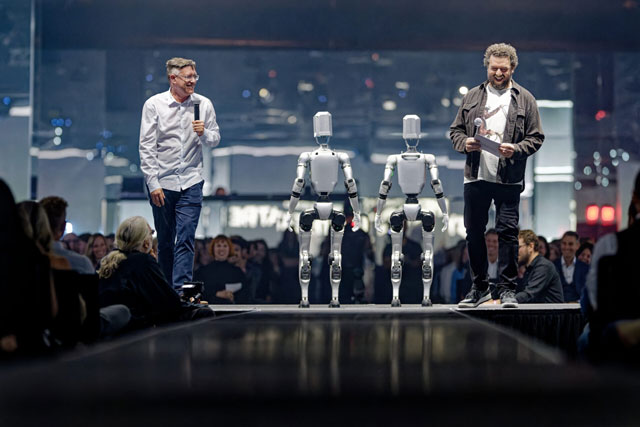
The real challenge isn’t whether AI will change art—it already has. But is AI-generated art, well, art?
Winkelmann goes back to the camera. “Everybody takes pictures. But do you consider yourself a photographer? Everybody can create digital art. But that doesn’t mean you’re an artist.”
Through it all, Winkelmann maintains the practice that started everything: a daily artwork, created and posted before midnight. It’s a discipline that grounds him, even as everything around him accelerates.
Each year, he experiments with different tools. For over a decade, it was Cinema 4D. More recently, it’s been AI-assisted processes—learning not just what the technology can do, but where it falls short. Because even in a world where images can be generated in seconds, there’s still a gap between something that looks right and something that feels right. And Winkelmann understands that. “While it’s often pretty close to matching what is in my brain, sometimes it’s too good, too average in a way, lacking in friction.”
That friction is what makes him an artist. It’s what captured his imagination back in fourth grade.
And maybe that’s what art is.