
Leading With Her Heart
07 Mar 2026
How educator Anita Huggins leans on small town lessons to implement big change
March-April 2026
Written By: Liz Regalia
How educator Anita Huggins leans on small town lessons to implement big change
By Liz Regalia
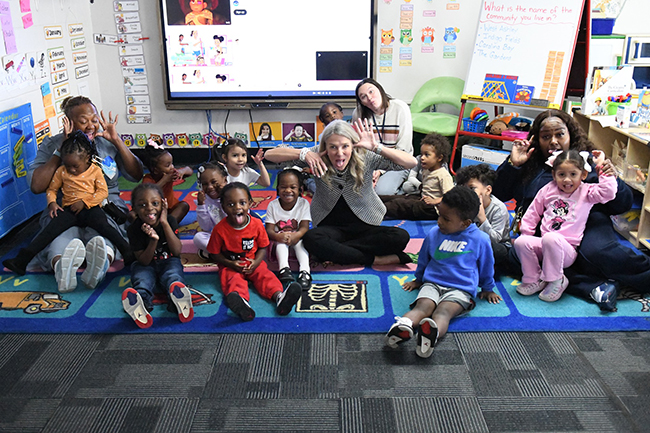
Anita Huggins grew up on a country road in Loris, South Carolina, that turned to mud when it rained. “I remember our car would bog down trying to get to our house at the end of that road because it was just dirt,” she recalls. “The neighbors would have to come help pull us out.”
Staring out the sunny windows of her corner office overlooking Calhoun Street where she leads the Charleston County School District (CCSD) as superintendent, Huggins begins to cry at the memory. “It’s really very humbling to reflect back over my course,” she says. “To see how God has put me in places that I would have never put myself, including this one.”
As nice as her office is, however, Huggins is the first to admit she doesn’t spend much time here. Over the course of her 28-year career as an educator for CCSD, she has always preferred to work surrounded by people, whether it be in a conference room, a classroom, or a cafeteria. As superintendent, that has not changed, even though much else has.
Growing up, all Huggins knew was education. “My mom was a teacher, and her sister, Brenda, was also an educator,” Huggins says. “I grew up in the church, and by the time I was in high school, I had my own 3- and 4-year-old class teaching little children. I also loved to sing, so I taught the children’s choir. Teaching was just who I was. It was in me. It was innate.”
Huggins attended Green Sea Falls High School, dubbed the “country school” in the small town of Loris, and she spent her summers in the farmland surrounding it. “We didn’t plan things with our friends if it was time for butter beans to come in,” Huggins says. “We were in the field beside everybody else suckering tobacco, shucking corn, and picking butter beans.”
After graduating first in her class, Huggins set off to see what else the world had to offer. She decided to pursue computer science at Coastal Carolina University—an adventure that lasted exactly three days. “Honey, I dropped that first course as fast as a hot potato,” Huggins says in her signature southern drawl. “I found myself right on over to the school of education where I was supposed to be, and the rest is really history.”
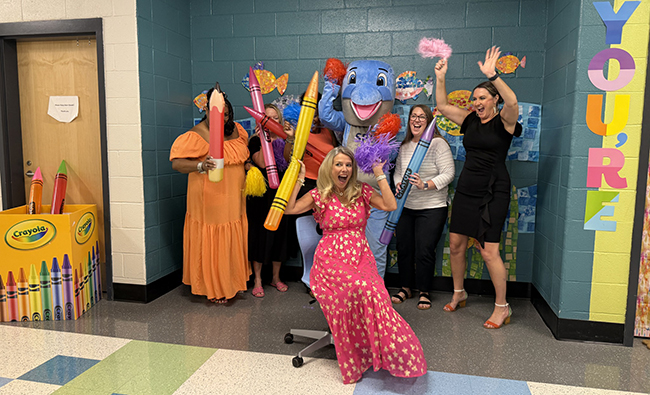
Huggins moved to Charleston after getting married with the intent to eventually return to Loris with her degree in education to teach and raise a family. But life had other plans in store. At 21, she applied for a job on James Island at Fort Johnson Middle School, which is now Camp Road Middle School. And to her surprise, she got it.
“Jim Mobley, the principal at the time, gave me my first teaching job,” Huggins says. “I’m forever grateful for that because I never thought anybody would hire me in Charleston, in the city talking like I talk. And he did. He took a chance on me.”
It was there that Huggins found a new home and fell in love with helping middle schoolers navigate the ever-challenging teenage years. She decided quickly that she wanted to further her own education. Huggins enrolled at The Citadel to earn her master’s in school administration, continuing to teach during the days while attending classes in the evenings.
“I really never thought I’d leave the classroom even after I finished my masters,” she says. “Until one day, a friend knocked on the door and said, ‘Listen, there’s this position at the district office for mentoring teachers and we think you’d be really, really great at it.”
That friend was right. Huggins transitioned to the district office and began her tenure on Calhoun Street where she evolved into leadership roles doing what she loves most: supporting the classroom, supporting teachers, and finding strategies that make a difference for children. After years learning alongside acting CCSD superintendents, she assumed the role herself in 2024.
“I’m honored to serve and focus on improving outcomes across a system where I’ve seen abject poverty negatively impact kids and nobody being able to do anything about it,” Huggins says. “I’ve been in the system a long time, and I feel like I can fix it with the people who I know are at the heart of it and a community that wants to see public education thrive for kids.”
As superintendent, one way in which Huggins has made strides in closing education gaps is through initiatives like LOCAL, an “adopt-a-school” program she launched in 2025 that allows local businesses and organizations to partner with CCSD. In less than a year, every one of the district’s 91 schools is now receiving community contributions, ranging from new books and learning experiences for students to lunches and mental health support for teachers.
While Huggins believes these relationships are vital for making a difference in schools, her focus remains on children. Specifically, when stepping into the superintendent role, she was adamant that she be evaluated by the CCSD Board of Trustees based on student achievement. In November of 2025, they did just that, giving her outstanding marks for the progress she has already made and extending her contract through 2031.
“Our students are achieving higher than they ever have before,” Huggins says. “The gap between Black and Brown children’s achievement and white student achievement is narrowing. But we still have a lot of work to do to get all our children ready for any future they want. We’ll continue to revise our goals, work hard, and allocate resources until we do get there.”
To ensure kids get the resources they need, Huggins led the charge to launch CCSD’s Weighted Student Funding (WSF) in June 2024, an equitable school funding model which delivers resources to schools based on the number of students who are in poverty, multilingual, or who have special needs.
“My job is removing barriers that keep the system from being successful,” Huggins says. “What we know about kids is that those who have specific challenges often need more support to achieve goals.” Since, a whopping $36 million has been allocated to WSF.
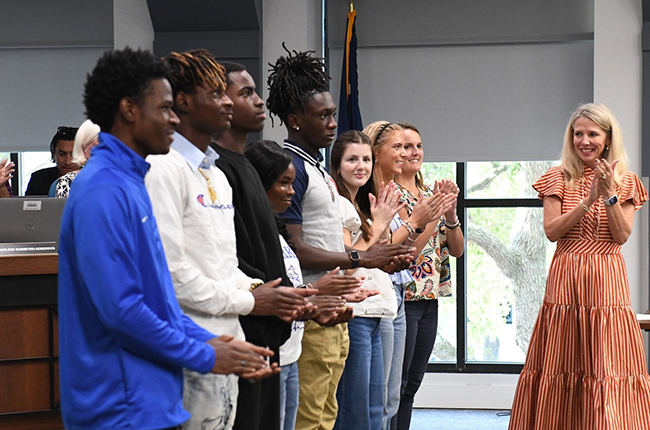
But as impressive as the numbers are, money alone is not how Huggins plans to fix the problems she has set out to solve as an educator, nor has it ever been. She is relying on lessons she learned long before she arrived in Charleston to ensure she leaves the education system—and community as a whole—better than she found it.
“It takes people pouring into other people,” Huggins says. “And that’s what I saw on that dirt road. When we needed help pulling our car out of the bog, it was people that came. It’s people working together with a common goal that improves outcomes. And that’s what it’s all about.”