On Display: Awash in Color
09 May 2026
Indigo: Variations in Blue at the Aiken-Rhett House
May-June 2026
Written By: Pamela Jouan | Images: Kim Graham
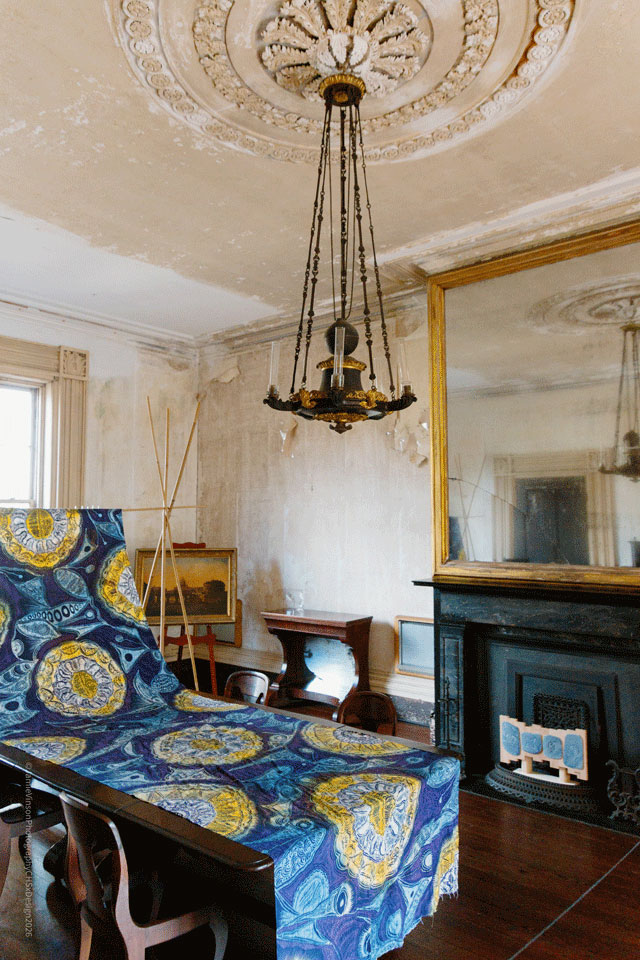
At the Aiken-Rhett House, time has a way of settling into the walls. The preserved “as-found” townhouse—its worn surfaces left intentionally untouched—doesn’t just tell Charleston’s story; it holds it. It’s hard to walk through the rooms and not hear the words echo back in loud whispers. Now, with Indigo: Variations in Blue, those stories take on new depth, washed in pigment that is as historically charged as the house itself.
Curated by Tushara Bindu Gude, Ph.D., an independent curator and art historian based in Charleston, South Carolina, the exhibition brings together eight artists whose practices span disciplines, geographies, and cultural lineages. Installed throughout the home, the works do not compete with the space as much as converse with it. Indigo seeps into the experience like a memory resurfacing, subtle in some rooms, striking in others, always present.
Works by Charleston-based artists Arianne King Comer, Hank Herring, Precious Jennings, Monique de La Tour, and Jim Martin are shown alongside those of Amina Ahmed, Nyugen E. Smith, and Genesis Tramaine, who developed their contributions during residencies in Charleston at the Foundation for Spirituality and the Arts. Together, their perspectives echo the global pathways of indigo itself—migratory, adaptive, and deeply rooted.
There’s something almost alchemical about indigo. It stains the hands of those who work with it, marking the body as much as the cloth. Several artists in the exhibition quite literally live with that mark—hands dyed blue through repeated immersion in the process. It’s a visual reminder that this is not simply an aesthetic exercise, but a physical, communal act of making. In many cases, the artists worked alongside one another, sharing techniques, stories, and time, forging a quiet community rooted in craft. They are quick to acknowledge each other for those connections, all made possible through Indigo. As Arianne King Corner quietly traced her life, she pointed to indigo as the connective thread throughout it.
That sense of connection mirrors Indigo’s own long and complicated journey. For centuries, the dye has been central to textile traditions throughout Southeast Asia—India, China, and Japan, and West Africa. It was prized for its depth of color and durability. In South Carolina, indigo was a powerful economic engine. From the late 1740s through the end of the 18th century, it was the colony’s second most valuable export after rice, its vivid blue shipped across Europe to fuel the textile industry.
But that history is inseparable from the labor cost that sustained it. Indigo cultivation and production in the Lowcountry depended on the forced work of thousands of enslaved people, many of whom carried with them deep knowledge of the plant and its uses. Today, indigo remains a powerful symbol within the Gullah Geechee community.
It’s within this layered context that “Indigo: Variations in Blue” finds its power. The result is less an exhibition and more an atmosphere. Indigo becomes a kind of protective layer within the house—a grounding presence that invites both reflection and release. There’s a quiet bravery in the work, a willingness to confront pain and displacement, and to allow the act of making to become a form of healing.
“Indigo: Variations in Blue” is on view through June 28, offering a rare opportunity to experience Charleston’s past and present in dialogue—where history is not just remembered, but reimagined, one shade at a time.
Get tickets at: historiccharleston.org/house-museums/aiken-rhett-house