LOCAL CHATTER: MAKING WAVES
02 Jul 2026
How two Charleston-bred boat builders are electrifying the day boat industry— literally
July-Aug 2026
Written By: LIZ REGALIA | Images: VOLARE BOATS
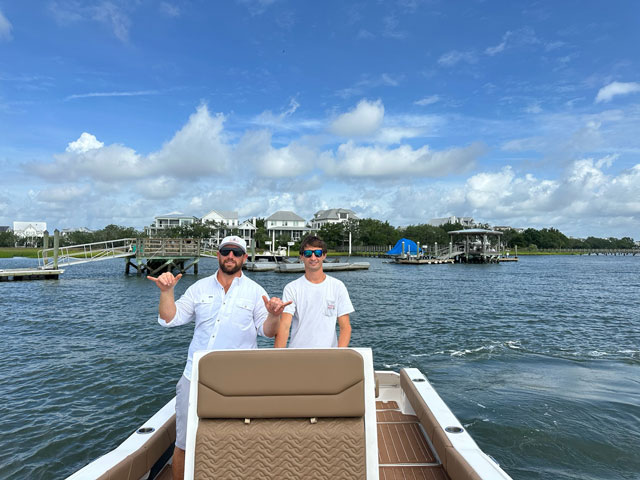
Volare Boats co-founder, Matt Moore, remembers spending more time on the water growing up in Charleston than on land. “I raced sailboats in the harbor, made offshore passages with my dad down to the Bahamas, Bermuda, even Havana, and taught sailing at the Carolina Yacht Club for seven bucks an hour and a free lunch,” Moore says.
Across town, his best friend, Dustin Tupper, the other co-founder of Volare Boats, was also living a life centered on the water. After watching his dad restore a wooden boat that his own father built in the 1950s, Tupper rebuilt a 30-foot pontoon boat in high school to take his friends on adventures.
The duo’s shared passion for boating as kids would collide in a shared career path. After earning degrees from Clemson University, they both spent a decade mastering boat building at every level at Scout Boats. Moore launched Scout’s Yacht Division while Tupper scaled their engineering team from three to upward of 40 members, driving innovation and growth.
But somewhere along the way, Moore got stuck on an idea he couldn’t shake: Why should people have to choose between a clean, quiet electric boat and a high-performing one? “The industry has always treated those as opposites,” Moore says. “I didn’t think they had to be.”
So, he set out to find a solution with Tupper. Leaning on their complementary strengths—Moore’s design instinct, Tupper’s technical depth—the lifelong friends left Scout to start Volare Boats, an electric boat-building company on a mission to upgrade the day boat industry.
The decision to focus on electric boats was partly to differentiate Volare in a crowded market, according to Moore. For example, going electric comes with eco-friendly perks as well as cost savings that gas-powered boats can’t offer. But the ultimate mission was much bigger. “We wanted to take back boating,” Moore says. “The goal was to make it easier for people, and electric lends itself very, very well to that.”
For starters, with electric boats, there is no engine to stall, no oil or filters to change, and no water pressures to maintain, Tupper explains. “The tremendous efficiency of the electric outboard also allows for precise control of the boat, whether that be near the dock, trailer, or a sandbar, which makes captaining a breeze,” he adds. Unlike a typical combustion engine motor, which spins at an idle RPM of 600 to 800 RPM, an electric motor spins at a much lower 100 RPMs. This allows boaters to maneuver in very small increments with gentle taps on a joystick.
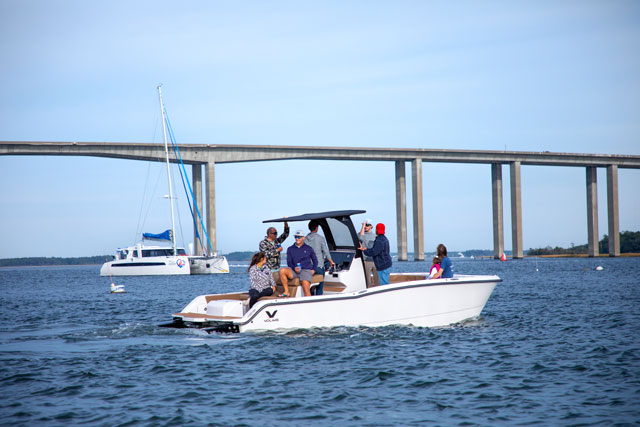
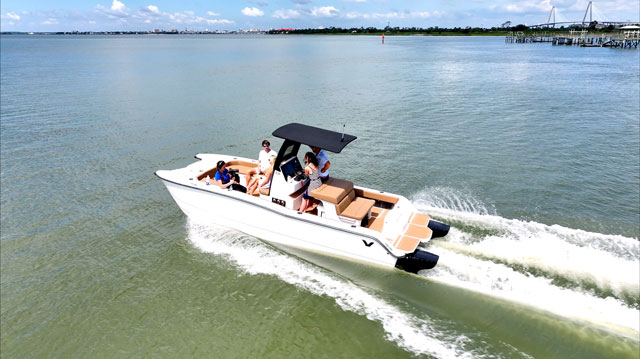
Knowing all that electric propulsion offers, Moore and Tupper engineered the Artemis 23, a first-of-its-kind semi-foiling electric catamaran designed specifically with Charleston boaters in mind. Think the Tesla of boats on the inside, but with the same classic profile of the Scouts on the harbor today.
Last month, I was lucky enough to climb aboard Volare’s flagship 23-foot electric day boat to get the full experience. Departing the Daniel Island Yacht Club, the quiet was the first thing you noticed—you hear the hull moving through the water, allowing the riders to hold a normal conversation without the vibrations of a gas-powered engine. But once the waves picked up, the conversation stopped, each of us blown away by how smooth the ride remained.
“The silky-smooth ride of the A23 was not by accident,” Tupper says. “To achieve the efficiency and range numbers needed to compete with gas-powered boats, a hydrofoil was chosen to lift the boat out of the water to reduce drag.” The foil that provides the boat lift for efficiency, also acts like a suspension system, Tupper adds, gently raising or lowering the boat with the waves. Aboard, this feels almost like you’re flying a few inches off the water rather than motoring through it. We watched in awe as the chop sent boats around us jolting up and down while we stayed steady, and not to mention, joyfully dry. I tensed up when I was invited to dock the boat, something I had never tried before. To my amazement, with the ease of a joystick and propellers that turn 90 degrees, I literally side-stepped into the spot.
“My favorite part is watching people’s faces the first time they ride on the Artemis 23,” Moore says. “You can see skepticism turn to belief almost instantly. In that moment, you can see we accomplished exactly what we set out to do: take back boating.”
So, what’s next? Currently, Moore and Tupper are focused on getting the word out about the Artemis 23 to a specific early-adopter market. But as they scale and the technology keeps improving, the goal is to bring Volare boats to the masses. “Electric boats are coming—the benefits are too real for them not to,” Moore says. “We just want to be first to the party.”
Learn more about the future of boating at volareboats.com